What to track in your first week after launch (and what to ignore)
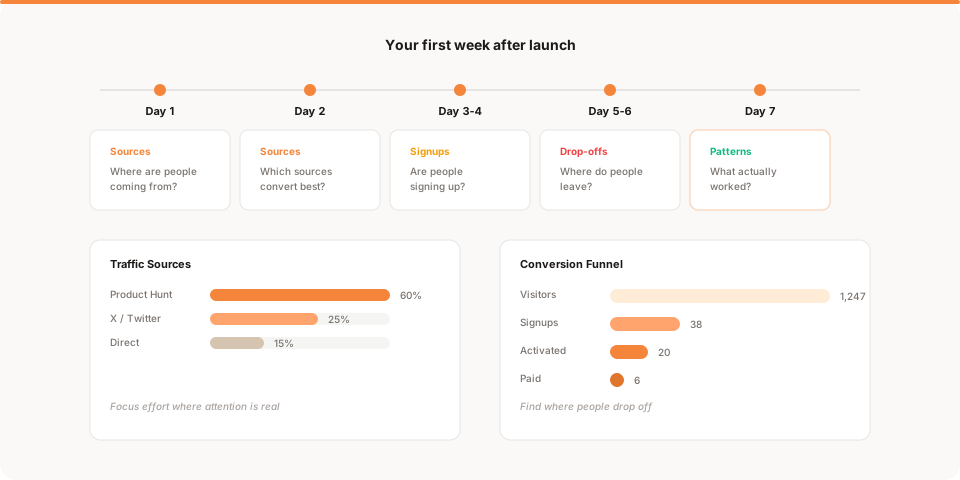
In your first week, track four things: traffic sources, signups, drop-offs, and daily changes. Ignore everything else.
You just launched. Now what?
You built something. You shipped it. Maybe you posted on Product Hunt, X, or a few communities.
Now traffic is coming in.
And suddenly you have a new problem.
You have no idea what to look at.
The first week after launch is both the most exciting and the most confusing moment in a product's early life. Traffic numbers move fast. Notifications pile up. Everyone has opinions. And in the middle of all that noise, you are supposed to figure out whether your launch actually worked.
The founders who learn the most from their launch weeks are the ones who knew in advance what they were measuring. They came in with a short list of questions and found answers to those questions, instead of scrolling through charts hoping something useful would jump out.
This guide tells you exactly what to put on that list.
Quick answer
In your first week after launch, focus on just four things:
- Where your traffic is coming from
- Whether people are signing up
- Where they drop off
- What changed day to day
Everything else can wait.
The biggest mistake founders make
Most people open their analytics tool and see dozens of charts, hundreds of numbers, filters, segments, and dashboards. Then they try to understand everything at once.
That is the fastest way to learn nothing.
Your job in week one is not to analyze everything.
Your job is to answer one question: "What is actually working right now?"
Day 1 to 2: Where are people coming from?
This is the first signal that matters.
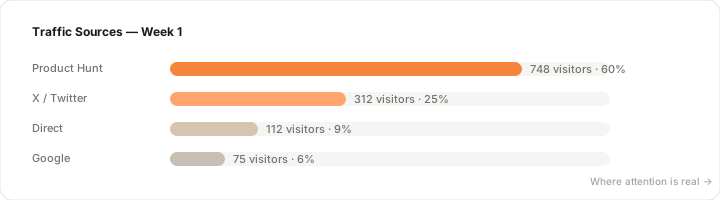
You need to know whether people are coming from Product Hunt, X, direct links, or somewhere unexpected. This tells you where attention is real.
What to look for:
- Top traffic sources
- Spikes after posts or launches
- Unexpected sources you did not plan for
If one source is driving most of your traffic, that is where your next effort should go.
Day 3 to 4: Are people signing up?
Traffic does not matter if nobody converts.
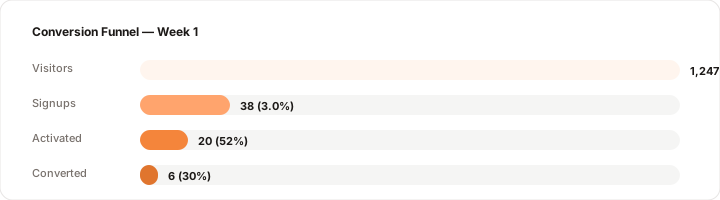
Now you look at visitors, signups, and conversion rate.
Ask yourself:
- Are people signing up at all?
- Is conversion above 2 to 3%?
- Did conversion change after a new source started sending traffic?
If conversion is low, your landing page needs work. If conversion is decent, your next problem is traffic quality and volume.
Day 5 to 6: Where do people drop off?
This is where most insights come from.
Look for pages with high bounce rates, steps where users leave, and onboarding drop-offs.
Ask yourself:
- Are people leaving immediately after arriving?
- Are they starting the signup flow but not finishing?
- Is there one specific step where most users stop?
Day 7: What actually worked?
By the end of the week, patterns start to appear. Now you zoom out.
Ask:
- Which source brought the best users (not the most, the best)?
- What day had the highest conversion?
- What changed right before that?
This is where you stop looking at charts and start forming insights. For a longer-term view of what to keep watching after week one, read the 5 metrics that actually matter for small products. For a deeper framework on evaluating whether your launch actually worked, see how to measure product launch success. And once the spike fades and you are trying to decide what to actually do next, what to do after you launch walks through the full post-launch analysis process.
What you do NOT need to track yet
This is important. In your first week, you do not need:
- Retention cohorts
- Lifetime value
- Complex funnels
- Segmentation dashboards
- Demographic breakdowns
These become useful later. Right now, they will only slow you down and distract you from the signals that actually matter.
The simple model to follow
Instead of dashboards, think in three questions:
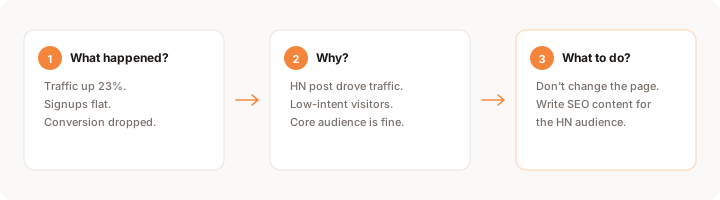
What happened? Traffic increased from a specific source.
Why did it happen? A post or launch drove it.
What should I do next? Double down on that channel. Or fix the page where people drop off.
This is the only loop you need in week one.
What this looks like in practice
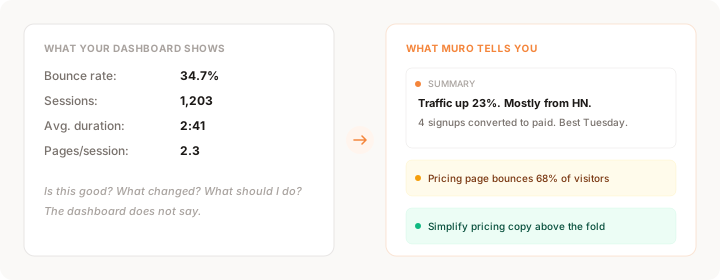
Instead of seeing "traffic increased by 32%" and wondering what it means, you want to know:
"Traffic increased after your Product Hunt launch. Most visitors came from there, but conversion was lower than from X. Consider improving your landing page for that audience."
That is an insight. It tells you what happened, why, and what to try next. A chart cannot do that on its own.
How to interpret what you find
Collecting the numbers is the easy part. Knowing what they mean is where most founders get stuck.
Here are the patterns to look for and what they usually mean.
Traffic is high but signups are low. This is the most common launch week disappointment. It almost always means traffic quality, not a broken landing page. A Product Hunt or Hacker News launch brings curious visitors, not buyers. Check whether your best-converting source (often direct or email) is still converting well. If it is, your page is fine. The new audience just did not match. For a detailed breakdown of this exact problem, traffic is high but signups are low walks through the diagnostic step by step.
Traffic is low but conversion is decent. This is actually a good signal. It means your page works for the people who find it. The constraint is reach, not relevance. Double down on whatever brought your best-converting visitors and ignore the channels that produced volume with no conversions.
Everything is low. If traffic is low AND conversion is low, you have two separate problems. Start with traffic because you need visitors before you can optimize conversion. Launch in more places. Get specific feedback on the landing page. One week of data is not enough to draw hard conclusions at very low volumes.
Spikes that drop off immediately. If you see a single huge day followed by a return to near-zero, you had a burst launch moment (a popular post, a front page placement). That traffic has a short half-life. The question is whether any of it stuck. Check activation rate for that day's signups specifically.
How much traffic is enough to trust week one?
One honest caveat runs under everything above: week one is a small sample, and small samples lie. Before you treat any pattern as real, ask whether you have enough data to trust it.
As a rough rule, you want at least 100 to 200 visitors from a source before its conversion rate means much. Below that, a single extra signup swings the percentage wildly, and you will fool yourself into "learning" things that are just noise. The same goes for day-to-day swings: two slow days after a launch spike is almost always the spike fading, not a problem you caused. So hold your conclusions loosely in week one. Treat the numbers as directional, note the patterns worth watching, and wait for volume to confirm them before you make an irreversible change. The founders who over-read a tiny first week usually spend week two undoing decisions they made on noise.
What counts as a successful launch week
Most founders do not define this before launching, which means they do not know how to evaluate the week once it is over.
Here is a simple framework. A launch week is successful if it does three things:
It tells you who your users are. The best channels are the ones where visitors recognize themselves in your product. If a niche developer community converted at 6% and Product Hunt converted at 0.4%, you learned something important about where your audience lives.
It identifies one thing to fix. Every launch reveals at least one gap: a confusing headline, a broken mobile layout, a pricing page with too much friction. If your week one data points at one specific thing to improve, you have a direction for week two.
It produces at least a handful of active users. Not just signups. Users who actually did something in the product. Even 5 to 10 activated users in week one is a real signal. Talk to them.
You do not need 1,000 signups in week one. You need enough data to know what to do next.
Why this is hard with most tools
Most analytics tools show you charts, numbers, and filters. They do not tell you what changed, why it changed, or what to do next.
So you end up guessing. You make changes based on gut feel. You check the dashboard again in a few days and nothing looks obviously different.
The problem is not that you lack data. The problem is that the data is not doing the thinking for you.
Where Muro fits in
Muro is built for exactly this stage.
Instead of a dashboard you have to interrogate, it emails you a short daily summary in plain English: what your traffic and signups did, where they came from, and how the numbers moved versus before, so a big change is easy to spot the next morning.
So instead of digging through charts, you read a short email that says something like:
"Signups rose yesterday, mostly from Product Hunt traffic. Your /pricing page bounced 68% of visitors, higher than any other page this week."
It tells you clearly what happened. Deciding what to do about it is still your call, but now you are deciding from a plain-language read instead of a wall of charts.
Common mistakes in the first week
A few things trip up almost every founder in week one. Knowing them in advance is half the fix.
Changing things too fast. Traffic is high, conversion feels low, and the temptation is to rewrite the landing page on day two. Resist this. Wait until the launch spike fades and you have steady-state data. Changes made during a spike are impossible to evaluate.
Checking the dashboard too often. Refreshing analytics every 30 minutes is not useful. It creates anxiety without producing signal. Set a schedule: check once in the morning. Look for day-over-day changes, not hour-over-hour fluctuations.
Comparing to other products. Someone on Indie Hackers got 800 signups from their Product Hunt launch and you got 60. That comparison is not useful. Different audiences, different products, different timing. Focus on whether your 60 signups did anything meaningful in the product.
Ignoring the activation data. Everyone watches traffic and signups. Almost nobody watches activation in week one. But activation is the most important number. 60 signups with 30 activated users is a much stronger result than 800 signups with 15 activated users. The first scenario has a real product. The second has a lot of abandoned accounts.
Turn week one into a week-two plan
The point of measuring week one is not the week itself, it is the plan it hands you for week two. Before you close the laptop on day seven, write down three things.
First, the one channel that converted best, because that is where your next batch of effort goes; everything that brought volume without signups can be politely ignored. Second, the one page or step that leaked the most, because that is your single highest-leverage fix, not a list of ten small tweaks. Third, a baseline: write down this week's traffic, signup rate, and activation, so that next week you are comparing against a real number instead of a feeling. That is the whole handoff. One channel to double down on, one thing to fix, one baseline to beat. Week two stops being a guessing game and becomes a short list you already made while the data was fresh.
What to do right now
If you are in your first week after launch:
- Focus on traffic sources
- Track signups and conversion rate
- Find the biggest drop-off
- Look for patterns, not perfection
Ignore everything else. That is enough to make better decisions than most founders make in their first month.
Keep reading
- How to act on your website data: a practical framework for turning analytics into decisions
- Why dashboards fail solo founders: why chart-first tools do not work for builders
- Muro for founders: see how Muro handles all of this automatically