The 5 metrics that actually matter for small products
Track five things: visitor count by source, signup rate, activation rate, top traffic sources, and bounce rate by page. Ignore everything else until you actually need it.
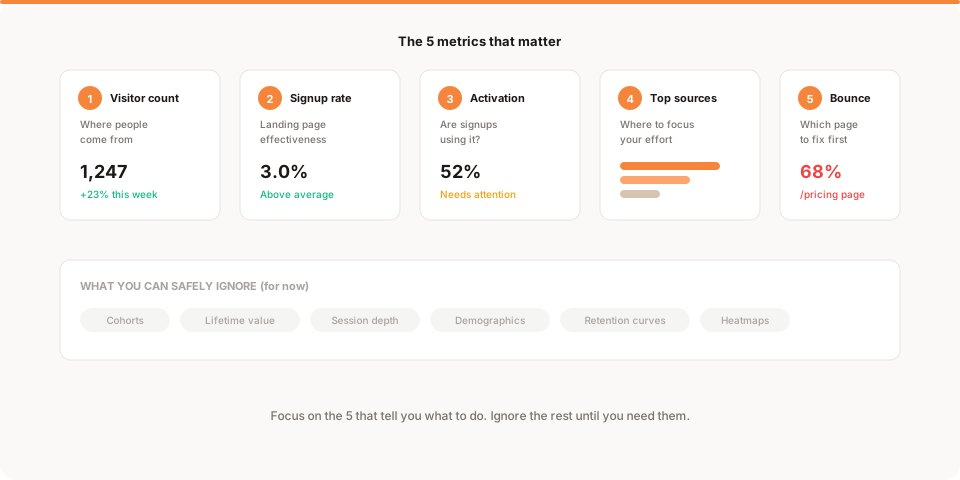
Most analytics tools show you dozens of metrics. Pageviews, sessions, bounce rate, time on page, pages per session, new vs returning, demographic breakdowns, device splits, referral paths, UTM tags, event counts, goal completions, and more.
You do not need most of them.
If you are running a small product, a side project, or an early-stage SaaS, you need five metrics. Everything else is noise at this stage. It will become useful later. Right now, it is a distraction.
Before getting into which five, it is worth understanding why the others are so tempting. The short version: most of the metrics that look impressive are ones that can go up while the business stays flat. The five below are the ones where a change actually tells you something.
Here are the five that actually tell you something useful, and what to do with each one.
1. Visitor count (by source)
Raw visitor count is often dismissed as a vanity metric. People say it does not matter how many visitors you get, only how many convert.
That is partly true. But visitor count matters when you know where those visitors come from.
1,000 visitors from Google organic is a very different signal than 1,000 visitors from a Reddit thread. The first means your content is working. The second means you got a one-time spike that may not repeat.
What to look at
Do not just check total visitors. Break it down by source:
- Organic search: people finding you through Google. This grows slowly but compounds.
- Direct: people typing your URL or using a bookmark. Usually your most engaged audience.
- Social: traffic from X, Reddit, Hacker News, LinkedIn. Often high volume but lower intent.
- Referral: other sites linking to you. Good for credibility and SEO.
What it tells you
If traffic is growing, ask where the growth is coming from. If it is flat, ask which source has the most room to grow. This tells you where to focus your next hour of effort.
When to worry
If traffic drops suddenly, check your sources. A drop in organic might mean a technical SEO issue. A drop in social might just mean your last post stopped trending. Context matters more than the number.
2. Signup rate
This is the single most important metric for most early products. It answers the question: when someone lands on your site, do they sign up?
Signup rate = signups / visitors. If you get 1,000 visitors and 30 sign up, your rate is 3%. If that number feels low, there are specific reasons why and specific ways to fix it.
What good looks like
For small products, 2% to 5% is typical. Anything above 5% is strong. Below 1% means your landing page, positioning, or traffic quality needs work.
But the absolute number matters less than the trend. If your rate was 2% last week and 3.5% this week, something is working. Figure out what changed.
What it tells you
A low signup rate with decent traffic means your landing page is the bottleneck. A decent signup rate with low traffic means the page is working but you need more visitors.
This is the metric that tells you whether to work on marketing or product. Most founders guess. This number gives you the answer.
Common mistake
Changing your landing page every week because the signup rate fluctuates. Small products have small sample sizes. Wait until you have at least 200 to 300 visitors before drawing conclusions. Daily fluctuations at low volume are noise, not signal.
3. Activation rate
Getting someone to sign up is step one. Getting them to actually use the product is step two, and it is where most small products lose people.
Activation rate = users who complete a key action / total signups.
The key action depends on your product. It might be:
- Completing onboarding
- Creating their first project
- Sending their first message
- Adding a tracking script
- Importing their first data set
If 100 people sign up and 40 complete that key action, your activation rate is 40%.
What it tells you
A low activation rate means your onboarding is too complex, your value prop is unclear after signup, or the product does not deliver what the landing page promised. This is the most common silent killer for small products. People sign up, poke around, and leave.
What to do about it
Find the exact step where most users stop. Is it step 2 of onboarding? The first empty state? The settings page? Look at the funnel, not just the top-line number. Then simplify that one step.
4. Top traffic sources
This is different from metric #1 (visitor count by source). Here you are not looking at volume. You are looking at quality.
The question is: which sources bring the visitors who actually sign up?
How to check
Compare conversion rate by source. You might find:
- Organic search converts at 4%
- Direct converts at 5%
- Reddit converts at 0.3%
- Product Hunt converts at 1.2%
This tells you that Reddit brings curious browsers, not buyers. And that organic search brings people who are actively looking for a solution.
What it tells you
Spend your time where conversions happen, not where traffic is highest. A source that brings 100 visitors with a 5% conversion rate is more valuable than one that brings 1,000 visitors with a 0.2% rate.
This is one of the most common analytics blind spots. Founders optimize for total traffic when they should be optimizing for converting traffic.
What to do about it
Double down on the sources that convert. If organic search works, write more content. If direct traffic converts best, invest in brand awareness and word of mouth. If a source does not convert, stop investing time in it unless you have a clear plan to improve the experience for that audience.
5. Bounce rate by page
Overall bounce rate is almost useless. A 40% bounce rate across your whole site tells you nothing specific. For a more complete guide to what startups should track vs ignore, see our website analytics guide.
Bounce rate by page is one of the most useful metrics you can check. It tells you which specific page is losing visitors, and that is a page you can fix.
What to look at
Find the page with the highest bounce rate that also gets meaningful traffic. That is your highest-leverage fix.
For example:
- Homepage: 35% bounce rate (normal)
- Blog post: 70% bounce rate (normal for content)
- Pricing page: 65% bounce rate (problem)
- Signup page: 55% bounce rate (big problem)
A high bounce rate on your pricing page means visitors are looking at your pricing and leaving without taking action. That is a specific, fixable issue.
What to do about it
Make one change to the highest-bounce page. Shorten the headline, clarify the CTA, simplify the layout, or remove distractions. Then check again in a week. This is the simplest way to act on your analytics without getting lost in a dashboard.
What you can safely ignore (for now)
This part is just as important as the five metrics above. Most analytics tools will tempt you with these. Resist.
Retention cohorts. Useful when you have hundreds of active users. Useless when you have 20.
Lifetime value. You need months of data and a meaningful sample size. Track revenue separately in Stripe for now.
Session duration. Longer sessions are not always better. A user who signs up in 30 seconds had a better experience than one who browsed for 10 minutes and left.
Pages per session. Same problem. More pages does not mean more value. Focus on whether people complete the action that matters.
Demographic breakdowns. Age, location, and device data rarely change your decisions at this stage. They become useful for ad targeting later.
Heatmaps. Fascinating to look at. Rarely actionable for small products. Save them for when you are optimizing a specific page with enough traffic to make the data meaningful.
The pattern behind these 5 metrics
Notice what all five metrics have in common. Each one answers a specific question:
- Visitors by source: Are people finding me, and where?
- Signup rate: Is my landing page working?
- Activation rate: Is my product delivering value after signup?
- Top sources: Where should I spend my time?
- Bounce rate by page: Which page should I fix first?
These are not chart-gazing metrics. They are decision-making metrics. Each one points to a clear decision.
That is the difference between analytics that helps and analytics that wastes your time. The right metrics make you faster. The wrong ones make you busier.
If five still feels like too many
In the earliest days, when traffic is a trickle and every number is noisy, even five metrics can be too many to act on. If that is you, collapse to one, and pick it by your current bottleneck.
If almost nobody is finding you, your one number is visitors by source, and your job is distribution. If people arrive but do not sign up, your one number is signup rate, and your job is the landing page. If they sign up but vanish, your one number is activation, and your job is onboarding. You move down the list only once the number above it is healthy. There is no point obsessing over activation when three people a day reach your site; fix the leak that is actually costing you the most first. A useful rule of thumb: your one number is the first stage of the funnel that is clearly broken, not the most interesting one to look at. The full five-metric view is where you graduate once you have enough traffic for the others to mean something.
Turn the five into a five-minute weekly review
The metrics only pay off if looking at them is a habit, so make it a small, repeatable one. Once a week, read the five in funnel order, top to bottom, because that mirrors how a visitor moves through your product. Start with visitors by source (did anything change in how people find me), then signup rate (is the page still converting), then activation (are new signups sticking), then top sources by conversion (where is the quality), then bounce rate by page (which single page is leaking).
As you go, write one sentence per metric: what it did and whether it changed. Most weeks, four of the five will be flat, and that is fine; flat is a valid, calming answer. The moment that matters is when one of them moves, and that is the metric you dig into while everything else waits. End the review by making exactly one decision based on what moved. Not five, one. A five-minute review that produces one clear decision will outperform an hour of dashboard grazing every week, because it ends in an action instead of a feeling. And if remembering to run the review is the part that slips, getting the five pushed to you as a short summary beats relying on willpower to open a dashboard.
Start here
If you are not tracking these five metrics today, start with one. Open your analytics, find your signup rate, and ask whether it is going up or down. That single number will tell you more about your product than a full dashboard ever could.
And if your current tool makes it hard to find these five numbers without building a report, that is a sign the tool was not built for you. It was built for a data team you do not have.
If you want a broader view of how these five metrics fit into the full startup analytics picture, including retention and revenue, the 7 most important metrics every startup should track connects them into a complete diagnostic system.