How to act on your website data (not just look at it)
The gap between knowing your data and acting on it is closed by one habit: asking three questions every time you open analytics. What happened. Why. What to do. One decision per session.
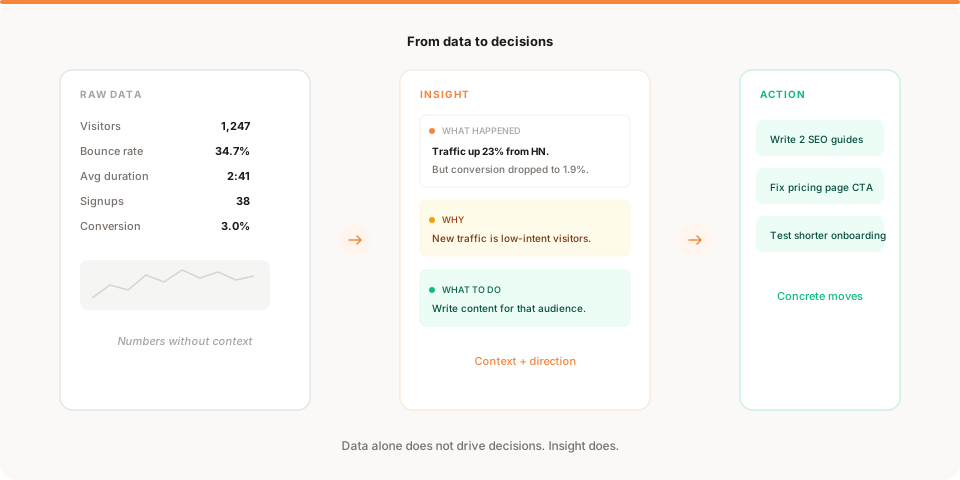
You open your analytics. You see numbers. Traffic went up. Bounce rate is 34%. Average session duration is 2 minutes and 41 seconds.
Now what?
If you are like most founders, the answer is: nothing. You close the tab and go back to building. Not because you do not care about the data, but because the data did not tell you what to do.
This is the most common analytics problem. It is not a lack of data. It is a lack of direction.
The knowing-doing gap
Most analytics tools are excellent at showing you what happened. Charts go up. Charts go down. Numbers change color.
But there is a gap between knowing what happened and knowing what to do about it. And most tools leave you standing in that gap.
You end up in a loop:
- Check analytics
- See numbers
- Feel like you should do something
- Not know what to do
- Close the tab
- Come back next week and repeat
This is not a personal failure. It is a design failure in the tools.
Why most people get stuck
The problem is that raw metrics do not carry context. A bounce rate of 34% means nothing on its own. Is that good? Bad? Did it change? Why?
A chart showing traffic over time tells you the shape of the line, but not the story behind it. You still have to figure out:
- Where the traffic came from
- Whether the visitors were the right people
- What they did after landing
- Where they stopped
- What, if anything, you should change
That is a lot of interpretation for someone who has 30 minutes before their next meeting.
The three-question framework
Here is a simple model that closes the gap. Every time you look at your data, ask three questions in order:
1. What happened?
State the fact. Be specific.
"Traffic increased 40% this week. Signups stayed flat. Conversion rate dropped from 3.2% to 1.9%."
2. Why did it happen?
Look for the cause. Check sources, timing, and recent changes.
"A Hacker News post drove 2,000 new visitors. Those visitors had a 0.4% conversion rate. Organic and direct traffic still convert at 3.8%."
3. What should I do?
Make one decision based on what you found.
"The landing page is fine for my core audience. I should write content that better targets the HN audience, or accept that this traffic source is awareness, not conversion."
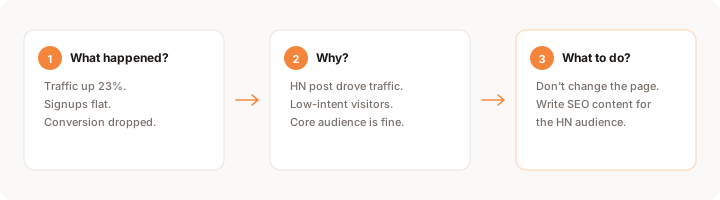
That is the entire framework. Three questions. One decision. No 45-minute dashboard session.
Example 1: Traffic spike
Your site normally gets 300 visitors a week. This week it got 1,800. You posted a thread on X that went semi-viral.
What happened? Traffic increased 6x. Signups went from 12 to 15. Conversion rate dropped from 4% to 0.8%.
Why? The X traffic had a 0.3% conversion rate. Organic and direct traffic still converted at 4.2%. The new visitors were browsing, not buying.
What to do? Do not change the landing page. It works for the right audience. Instead, consider writing content specifically for the X audience, or simply recognize that social traffic is top-of-funnel for your product.
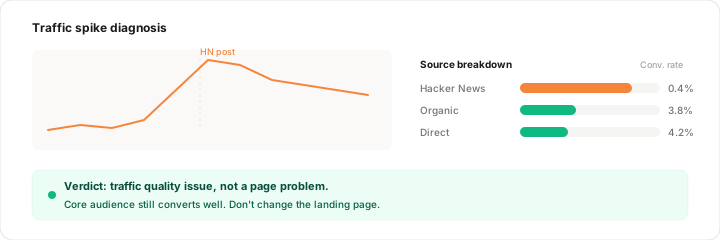
The wrong move here would be to rewrite the landing page. The page is not the problem. The audience mismatch is. For a deeper dive on this exact pattern, read traffic is up but conversions are down.
Example 2: Conversion drop
Your signup rate dropped from 3% to 1.5% over the past week. Traffic is unchanged.
What happened? Conversion rate halved. Traffic volume and sources are stable.
Why? You redesigned the signup page last Tuesday. Since then, 60% of visitors reach the signup page but only 15% complete the form. Before the redesign, 30% completed it.
What to do? The signup form is the bottleneck. Compare the old and new versions. Check whether you added fields, changed the CTA, or broke the mobile layout. Revert or simplify.
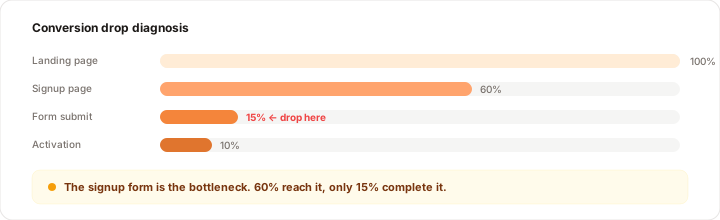
This is a case where the data clearly points to one page and one change. The fix is specific.
Example 3: Flat growth
Traffic is steady. Signups are steady. Nothing is broken, but nothing is growing either.
What happened? No change for 3 weeks. 400 visitors per week. 12 signups per week. 3% conversion rate.
Why? Traffic sources are stable: 60% organic, 30% direct, 10% referral. No new channels are growing. The existing audience is converting well, but the funnel is not getting wider.
What to do? The product and page are working. The constraint is traffic, not conversion. Focus effort on one new acquisition channel: a blog post series, a community launch, a partnership. Do not optimize the landing page further. It is already converting the people who arrive.
This is the least dramatic example, but it is the most common. Most small products are not broken. They are just not growing because the founder is optimizing the wrong thing.
Where most tools fail
Traditional analytics tools show you the "what happened" step well. Charts, numbers, time series. They are good at that.
But they stop there.
They do not tell you why something changed. They do not connect the traffic spike to the source. They do not tell you that conversion dropped because of a specific page. They do not suggest what to try next.
So you see the data, feel the gap, and close the tab.
The problem is not that you need more data. You need the data to do more of the thinking for you. If you are still figuring out what to even look at, start with our guide to website analytics for startups.
Where Muro fits in
Muro is built around the first step of this framework, done for you.
Every morning, it sends you a plain-English summary that answers "what happened" without you opening anything: your visitors and signups, where they came from, your top pages, and how each number moved versus before. That is the step most founders never get a clean read on, because it is usually buried in charts.
Muro does not pretend to answer "why" or "what to do" for you; those are your calls. What it does is surface the context that makes them answerable, the source that moved, the page that shifted, the metric that jumped, so you are reasoning from a clear read instead of digging for one. You bring the judgment; Muro removes the digging.
If you want to see what this looks like in practice, here is a sample morning brief and here is how the first week works after you set it up.
How to build the habit
The three-question framework only works if you use it consistently. Here is how to make it a habit rather than an occasional exercise.
Set a fixed time. Analytics works best as a daily or weekly ritual, not a reactive check. Monday morning is a common choice because you can review the previous week and set a direction for the current one. Pick a time that fits your schedule and protect it.
Write down your question before you open the tool. This is the single most important habit. Before you open any dashboard or analytics view, write down one question you want to answer. "Did the new CTA change the signup rate?" or "Is organic traffic still growing?" Having the question written forces you to actually find an answer instead of browsing until something catches your eye.
Limit each session to one decision. When you find an answer, make one decision and stop. "Change the pricing page CTA." "Write a follow-up piece for the keyword that drove this week's organic spike." One decision, logged somewhere, acted on. Done.
Do not act during spikes. When traffic spikes from a launch or a viral moment, resist the urge to make page changes. The spike changes your numbers in ways that make normal-state analysis impossible. Wait for the traffic to settle, then evaluate.
The difference between monitoring and investigating
There are two modes of analytics usage: monitoring and investigating. They serve different purposes and need different approaches.
Monitoring is checking in on known metrics to confirm they are stable. "Conversion rate is still around 3%. Traffic is growing at the usual rate. Nothing is broken." This should take 2 to 3 minutes. If monitoring is taking longer, your setup is too complex.
Investigating is going deeper because something unexpected happened. Conversion dropped. A new traffic source appeared. Signups spiked. Investigating is where the three-question framework earns its keep. You are trying to understand a specific change, not just confirm the current state.
Most founders conflate these two modes. They try to investigate every time they check analytics, which is exhausting. The better approach is to monitor quickly each day and only switch into investigation mode when something actually changes.
When the right answer is to do nothing
Here is the permission most analytics advice forgets to give: sometimes the correct output of the three questions is no change at all, and that is a real decision, not a cop-out.
If the "why" turns out to be noise (a two-day dip at low volume, a spike from a one-off mention), the honest "what to do" is nothing, because acting on noise just adds churn. If the numbers are flat and the flat is healthy (people arriving, converting, and activating at your normal rate), the honest "what to do" is keep going, not invent a problem. And if you simply do not have enough data yet to answer the "why" with any confidence, the honest "what to do" is wait and gather more, not guess.
Founders get into trouble when they feel that opening analytics obligates them to change something. It does not. A session that ends in "nothing moved that matters, carry on" is a successful session. The best operators I know change fewer things than they could, not more, and they wait for a signal loud enough to be worth a decision. The framework is there to license action when it is warranted and, just as importantly, to license inaction when it is not.
What the framework does not solve
The three-question framework works best for diagnosing what is happening and deciding what to do about it. It does not replace the need for good instrumentation, the right metrics, or a product that users actually want.
If your analytics setup is missing important data (no signup tracking, no source attribution, no page-level data), the framework cannot help because you cannot answer the "why" question without the right data points.
If you are not sure which metrics to track in the first place, the five metrics that matter most for small products tells you exactly where to focus.
And if you are asking the right questions about the wrong metrics (vanity metrics that can go up while the business stays flat), the framework will produce confident-sounding but useless answers. Vanity metrics vs real metrics explains how to tell the difference. If you have multiple broken things visible at the same time and are not sure which problem the three questions should target first, how to decide what to fix first covers the triage process in full.
The simplest thing you can do today
If you are not acting on your data right now, start with this:
- Open your analytics
- Find the page with the highest bounce rate
- Ask: what happened, why, and what one change could I make?
- Make that one change
- Check again in a week
That is it. One page. One question. One change.
You do not need a data team. You do not need a complex tool. You need a habit of asking the right three questions, consistently, with a real decision at the end of each session.
If your current tool makes that easy, great. If it does not, there are better options.