What to do after you launch (and how to actually learn from it)
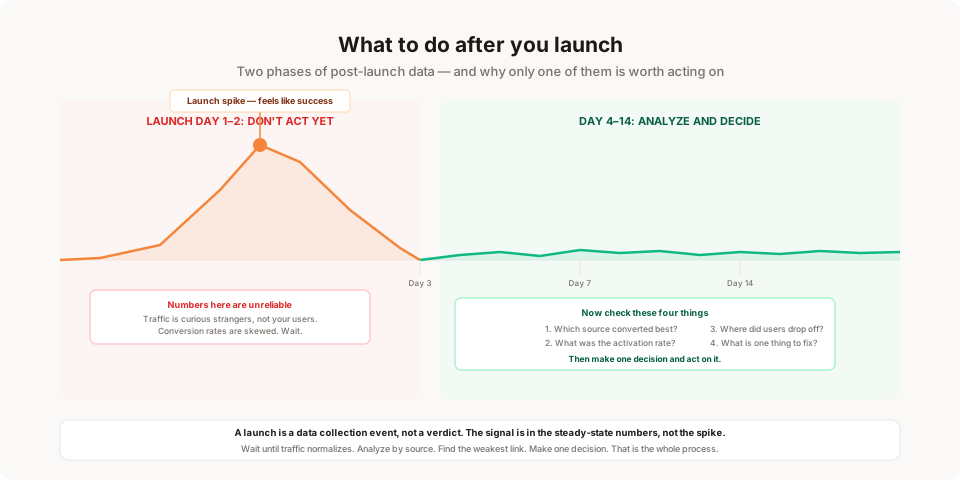
A launch is a data collection event, not a verdict. The signal is in the steady-state numbers, not the spike. Wait for traffic to normalize, analyze by source, find the weakest link, and make one decision. That is the whole post-launch process.
The launch is done. The traffic spike is fading. The congratulations messages in Slack have gone quiet. Your Product Hunt post has scrolled off the front page.
You open your analytics dashboard on Tuesday morning. There are 54 visitors from yesterday, 8 new signups, and a conversion rate chart that looks nothing like the mountain from launch day.
Now what?
This moment, the day the spike is gone and you have a screen full of numbers you are not sure how to read, is where most founders make their worst decisions. They either panic and start rewriting things, or they feel good about the launch buzz and move on without extracting any real signal from what happened.
Neither reaction is useful. But there is a third option.
The launch spike problem
Launches produce a specific type of data that is almost designed to mislead you.
On day one, everything looks enormous. Thousands of visitors. Traffic charts that spike off the screen. A conversion rate that looks low compared to all that traffic but still represents more signups than you have ever seen in a single day.
The problem is that launch traffic is not your traffic. The people who visit your product on Product Hunt day are a highly specific, atypical audience. They are browsing launches, not searching for solutions. They are curious, not committed. Many of them will never return to your product category. Their behavior on your site does not represent how your actual target users behave.
Decisions made based on launch day numbers are often wrong in both directions. You might conclude your conversion rate is broken when really it is just low because of traffic source. You might conclude your product is resonating when really only a narrow slice of launch visitors actually activated.
The first discipline of post-launch analysis is this: observe everything on day one, but decide nothing until the spike is gone.
When to actually look at the data
Check high-level numbers (raw traffic, rough signup count) on launch day. You want to know roughly what happened and whether anything is completely broken.
Then wait. Day 3 or day 4 is usually when traffic has normalized enough to tell you something real. By day 7, you have a full picture.
What changes after the spike:
The conversion rate you see on days 5 through 7 is much closer to what your product can actually do with normal traffic. If it is 4%, that is a meaningful signal. If launch day showed 0.7%, that was mostly noise from low-intent visitors.
The activation rate you see after the spike is more honest too. The people who signed up during the launch and then used the product on day 2 or 3 were genuinely interested. The ones who signed up and never came back were mostly browsers.
What not to do in the first 48 hours
There are a few predictable mistakes that happen in the window right after launch. Knowing them in advance saves you from the most expensive ones.
Do not rewrite the landing page. This is the most common overreaction. Traffic is high, conversion looks low, the temptation is to gut the headline and try something new. But you cannot tell what is causing the low conversion during the spike. Maybe it is the page. Maybe it is just that Product Hunt traffic converts at 0.4% for every product ever built. Wait until you can separate the sources and see which one is actually underperforming.
Do not compare your numbers to someone else's launch. Someone in your community just posted that their Product Hunt launch got 800 signups. You got 60. This comparison is not useful. Different products, different audiences, different timing, different distribution channels, different pricing, different onboarding. The only relevant question is whether your 60 signups did anything meaningful in the product.
Do not declare failure based on total traffic. If your launch did not produce the traffic spike you hoped for, that is a distribution problem, not a product problem. A small launch that sends 200 visitors with a 6% conversion rate is a better result than a large launch that sends 4,000 visitors at 0.3%. Volume is not success. Conversion quality is.
Do not declare victory based on the spike. The opposite mistake is equally damaging. A big traffic day that produced 12 activated users is not a successful launch. It is an audience awareness event. Real product success is measured by what happens in week two, not week one.
The post-launch analysis framework
After the spike fades, sit down and answer these questions in order. How to measure product launch success covers the full framework for setting up this analysis before you launch. This is the version you run after.
Question 1: Which source converted best?
Break down your signups by traffic source. Product Hunt, Twitter, newsletters, Reddit, organic, each one is a separate channel with a separate conversion rate.
The number that matters is not how many visitors each source sent. It is the percentage of those visitors who signed up. A Slack community that sent 80 people with 7 signups (8.7%) is more valuable than a Product Hunt launch that sent 4,000 with 20 signups (0.5%).
If you cannot separate sources cleanly because you did not set up UTM parameters or referral tracking before launch, note that for next time. This is the most important measurement to have.
Question 2: What was the activation rate, by source?
Of the signups from each channel, how many completed the first meaningful action in your product?
This is the filter that separates real users from tourists. Someone who signed up and never returned might as well not have signed up. Someone who signed up, activated, and came back three times in the first week is a user.
If activation rate is low across all sources (below 20%), onboarding is probably the issue, not the launch. That is a different problem with a different fix.
If activation is decent for some sources and near-zero for others, you have found which channels bring real users and which bring browsers.
Question 3: Where did people drop off?
Look at where in the funnel visitors stopped. Did they hit the landing page and bounce immediately? Did they start the signup form but not finish? Did they sign up but never complete onboarding?
Each dropout point has a different cause. Immediate bounce usually means the visitor did not recognize themselves in the product (audience mismatch or headline mismatch). Signup form abandonment usually means friction in the form itself. Onboarding dropout usually means the path to first value is too long.
Identifying the specific dropout point tells you where to direct energy. Fixing the wrong step wastes a week of effort.
Question 4: What did your best users have in common?
If you have even 5 to 10 activated users from the launch, look at where they came from. What source brought them? What did they do in the product first? How quickly did they reach first value?
These users are your signal. Everything you learn about them is more valuable than aggregate launch statistics. If all of them came from the same niche community, that community is where your audience is. If they all activated by doing the same thing in the product first, that action should be the entry point you optimize.
Reading the three most common launch results
Most launches fall into one of three patterns. Here is what each one means and what to do next.
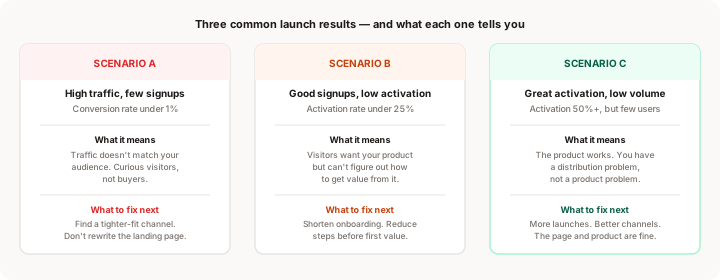
Scenario A: High traffic, poor conversion
You drove a lot of visitors and very few signed up. This is the most common and the most often misdiagnosed.
The instinct is to blame the landing page. The actual cause is usually traffic source. Launch traffic is the least intent-driven traffic you will ever get. People on Product Hunt are browsing, not searching. When you break the numbers down by source, you will almost always find that direct, email, and organic traffic converts at a meaningfully higher rate than the launch platform traffic.
What to do: do not rewrite the landing page yet. Instead, find the source with the highest conversion rate (even if it is small) and focus your next effort on reaching more people from that type of channel. The landing page may be fine. The audience just did not match.
Scenario B: Good signups, low activation
People signed up. They seemed interested. But very few of them actually used the product.
This is an onboarding problem, not a launch problem. The launch worked: it got people to give you their email. But the experience between signup and first value lost them. The path was too long, too confusing, or started with setup before showing any output.
What to do: find the specific onboarding step where most people stopped. Fix that step first. This is a shorter path to first value problem, and the fix is almost always removing steps rather than adding guidance.
Scenario C: Great activation, tiny numbers
The people who signed up loved it. Activation was high. Some came back. But the total numbers were small.
This is the best problem to have. The product is working. The experience is solid. What you have is a distribution problem, not a product problem.
What to do: launch again, in better places. The first launch taught you that when the right person finds your product, they use it. Your job now is to reach more of those people. More channels, better targeting, more launches. Do not change the product or the page.
Deciding what to fix first
You have your analysis. You have identified a few problems. Now you need to decide which one to work on.
The rule is simple: fix the earliest broken thing in the funnel first.
If traffic is the problem (too few visitors), everything downstream is meaningless. You need more people before you can optimize conversion. Get more traffic first.
If conversion is the problem (traffic is decent but nobody signs up), get traffic fixed first, then ask whether it is an audience problem or a page problem.
If activation is the problem (signups exist but no one uses the product), the landing page does not matter yet. Get the activation number up before spending more on distribution.
Each problem requires a different fix, and fixing them out of order wastes effort. You cannot optimize your landing page if you have no traffic. You cannot fix activation if you have no signups.
The two-week review
The most useful post-launch ritual is a structured review two weeks after launch day.
At that point, the spike is long gone, you have a week or two of normalized traffic, and any users who were going to come back from the launch have either come back or not.
Sit down and answer these five questions:
- Which source produced the users most likely to return?
- What was the activation rate for launch signups versus regular signups?
- What is the one change that would have improved the result most?
- What channel deserves more effort based on what you learned?
- What is the one thing to ship in the next two weeks based on this data?
Write down the answers. Make one decision. Do not make five.
Retention in the first two weeks is the real measure of whether the launch produced users or just traffic. If your activated launch users are returning on day 7 and day 14, the launch built something real. If they signed up and disappeared, the product experience needs attention before the next launch.
A launch is one experiment, not a verdict
A single launch does not define your product. It gives you one round of data about one set of channels at one point in time.
The founders who learn the most from launches treat them as experiments with hypotheses, not events to survive. Before the launch, they write down what they expect to see. After the launch, they compare what they expected to what actually happened. The gap between expectation and reality is where the learning is.
If you expected 100 signups and got 20, but those 20 activated at 60%, the hypothesis to test next is not "how do I get more signups" but "where can I reach more people like those 20."
If you expected 3% conversion and got 3% conversion but only 10% activation, you already have your next hypothesis: the onboarding experience, not the top of the funnel, is where users are leaving.
The data after a launch is not a report card. It is a set of questions about what to test next. Answer those questions and the next launch gets sharper.
Keep reading
- How to measure product launch success: the framework for defining success metrics and channel attribution before and during launch
- Which traffic source converts best: how to compare channels by conversion quality, not volume
- What is user activation: how to define and measure whether launch signups actually used the product
- Why users don't come back: how post-launch retention connects to whether activation happened
- Muro for builders: launch tracking with plain-language insights that tell you which channel converted and where users dropped off