Google Analytics vs Plausible: an honest comparison (2026)
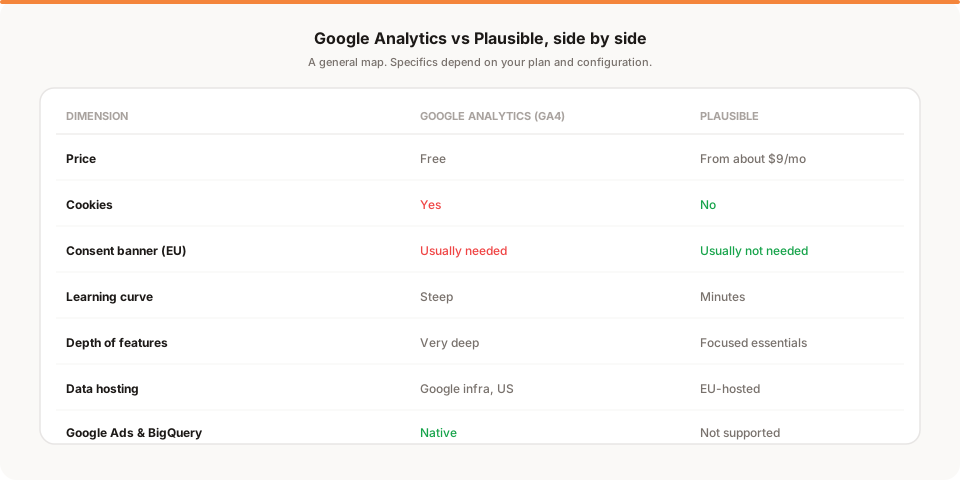
Google Analytics and Plausible solve the same problem in opposite ways. Google Analytics is free and extremely powerful, with deep reporting and native Google Ads and BigQuery integration, but it uses cookies, usually needs a consent banner in the EU, and has a steep learning curve. Plausible is a paid tool starting around $9 a month that is cookieless, EU-hosted, GDPR-friendly by design, and simple enough to understand in minutes, but it deliberately covers only the essentials. Choose Google Analytics if you need deep analysis and Google ecosystem integration; choose Plausible if you want privacy, speed, and simplicity.
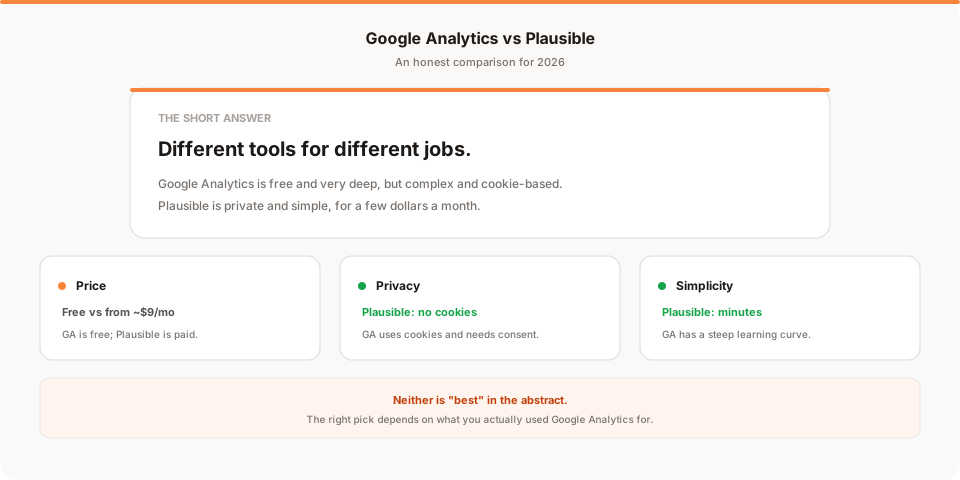
Short answer: Google Analytics and Plausible are both good, and they're built on opposite philosophies. Google Analytics is free and collects as much as it can, which makes it deep but complex, cookie-based, and consent-heavy. Plausible is a paid tool that collects as little as possible, which makes it private, simple, and fast, but lighter on advanced features. The right pick comes down to what you actually used Google Analytics for.
If you're comparing these two, you've probably already sensed the tension. Google Analytics is the default, it's free, and it does almost everything. Plausible costs money, does less, and yet people keep switching to it and sounding relieved afterward. This post explains why, without pretending either tool is perfect.
Quick disclosure: I'm the founder of Muro, a privacy-friendly analytics tool that competes with both of these. I've worked to keep this comparison fair rather than steering you toward my own product. Muro gets one honest mention near the end, and you should ignore it if a dashboard suits you better.
The short version
If you want the answer before the detail: choose Google Analytics if you rely on deep reporting, audience segments, attribution modeling, or native Google Ads and BigQuery integration, and you're willing to manage cookies and consent to get them. Choose Plausible if you want a private, cookieless, EU-hosted tool that you can understand in minutes and that usually lets you skip the consent banner, and you're comfortable paying a few dollars a month for that simplicity.
Most small sites lean toward Plausible once they're honest about how little of Google Analytics they ever touched. Larger teams with serious ad spend or data science needs tend to keep Google Analytics, sometimes alongside a simpler tool. Now the detail.
Price: free versus a few dollars a month
This is the most obvious difference, and also the most misleading.
Google Analytics is free. There's a paid enterprise tier (Analytics 360), but the version almost everyone uses costs nothing in cash. Plausible is paid, with usage-based pricing that starts around $9 a month for a small site and scales with your pageviews.
Here's the honest reframing, though. "Free" describes the invoice, not the total cost. Google Analytics asks you to pay in setup time, in the consent banner you have to add and maintain, and in the data you lose when visitors reject that banner. Plausible asks you to pay a small, predictable fee and hands you simplicity in return. So the real question isn't "free versus paid." It's whether the money you'd spend on Plausible is worth less to you than the time and data you'd spend keeping Google Analytics honest. For a lot of founders, it is.
Privacy and consent: the biggest practical difference
If there's one dimension that decides this for most people, it's this one.
Google Analytics uses cookies and processes data that can identify people, such as IP-derived identifiers. Under GDPR and related EU rules, that usually means you need a cookie consent banner and valid consent before it runs. Plausible was built the opposite way: no cookies, no personal data, no cross-site tracking. Because it doesn't collect personal data, it generally doesn't require a consent banner in the EU.
That difference cascades into everything. No consent banner means no friction on the first thing a visitor sees, no data lost to people clicking "reject," and far less to explain in your privacy policy. It's also why Plausible describes itself as GDPR-friendly by design rather than something you configure your way toward. If you want the deeper background on why Google Analytics carries this baggage, I wrote a full piece on whether Google Analytics is GDPR compliant.
To be fair to Google Analytics: GA4 did add privacy features, including IP anonymization by default and consent controls. Those help. But they don't change the fundamental fact that it relies on cookies and consent in a way Plausible simply doesn't.
Ease of use
Open Google Analytics for the first time and you meet a wall. GA4 in particular is powerful but genuinely hard to learn: events, parameters, explorations, custom reports, and a navigation structure that changed a lot from the version people knew. Even experienced marketers keep tutorials open.
Open Plausible and you see a single page. Visitors, sources, top pages, countries, devices, and your goals, all on one screen you can read in a glance. There's almost nothing to learn, because there's almost nothing hidden. That simplicity is a deliberate product decision, not a missing-features accident.
Which is "better" depends on you. If you love slicing data and building custom reports, Google Analytics rewards the effort. If you just want to know how your site is doing without a training course, Plausible is a relief.
Depth of features
This is where Google Analytics earns its reputation.
Google Analytics can do things Plausible doesn't attempt: detailed audience segmentation, funnel and path exploration, attribution modeling across channels, integration with Google Ads for campaign optimization, and free export to BigQuery for custom analysis. If your growth depends on paid acquisition or serious data work, those aren't nice-to-haves, they're the job.
Plausible covers the essentials well: unique visitors, pageviews, sources and referrers, top pages, entry and exit pages, countries, devices, UTM campaign tracking, custom events, and goal conversions. Its Business tier adds funnels and a few more advanced views. But it stops well short of Google Analytics on depth, on purpose. It's answering "how is my site doing" cleanly, not "let me model the marginal contribution of every channel."
So if you find yourself listing advanced Google Analytics features you actually use, that's a signal to keep it. If you're struggling to name three, that's a signal you're paying the complexity cost for nothing.
Accuracy: what each one actually captures
This one surprises people. The free tool often captures less real data than the paid one.
Because Google Analytics needs consent in the EU, every visitor who rejects or ignores the cookie banner is a visitor it can't fully count. Depending on your audience, that can be a large slice of your traffic simply missing from your reports. Plausible, collecting no personal data and needing no banner, counts everyone by default. So the tool you pay for can give you a more complete picture of your traffic, while the free tool quietly undercounts.
Neither is a perfect census. Google Analytics also samples data on very large sites, and any two tools will disagree on exact numbers because they count differently. The point isn't that one is flawless. It's that "free" doesn't mean "more accurate," and often means the opposite once consent enters the picture.
Data ownership and hosting
Google Analytics runs on Google's infrastructure, which has historically involved sending EU visitor data to the US. The 2023 EU-US Data Privacy Framework created a legal basis for those transfers, but the data still lives inside Google's ecosystem, and Google's business model is built on data.
Plausible hosts its data in the EU and, being open source, can even be self-hosted if you want full control. It doesn't share your data or use it for advertising. For teams that care about where their analytics data physically sits and who can touch it, that's a meaningful difference, not just a talking point.
Integrations
Google Analytics wins here without much contest. It plugs natively into Google Ads, Search Console, and BigQuery, and a huge ecosystem of tools assumes you're running it. If your workflow lives inside Google's products, that gravity is real and worth respecting.
Plausible offers a clean stats API, weekly email and Slack reports, and shareable public dashboards, which cover the common needs. But it doesn't pretend to slot into the Google Ads optimization loop. If that loop is central to how you spend money, Plausible won't replace it.
Which should you choose?
Here's the decision in plain terms.
- Keep Google Analytics if you run meaningful paid advertising, need attribution across channels, do custom analysis in BigQuery, or genuinely use its advanced reporting. The complexity buys you something real.
- Switch to Plausible if you want privacy by default, no consent banner, a script that loads fast, and a dashboard you actually understand, and you're fine paying a small monthly fee for that.
- Run both for a couple of weeks if you're unsure. Install Plausible alongside Google Analytics, compare what each tells you, and notice which one you actually open. That habit is the most honest signal you'll get.
If you want the three-way version of this that adds Simple Analytics to the mix, I compared them in Google Analytics vs Plausible vs Simple Analytics. And for the wider field of privacy-friendly options, the best privacy-friendly analytics tools for 2026 walks through the whole category.
Can you switch without losing your history?
This is the fear that keeps people on Google Analytics longer than they'd like: years of historical data they don't want to abandon. It's a fair worry, and the honest answer is that you don't have to choose in a single dramatic moment.
The clean way to move is to run both tools in parallel for a while. Add Plausible alongside Google Analytics and leave Google Analytics collecting exactly as it does now. For a few weeks or a couple of months you'll have both sets of numbers, which does two things: it lets you sanity-check Plausible against a tool you already trust, and it keeps your Google Analytics history growing in the background in case you ever need it.
There's no automatic way to import years of Google Analytics data into Plausible, and most people find they don't miss it. Historical data feels precious until you try to use it, at which point you realize you almost always care about recent trends, not what happened three years ago. If you do want the archive, keep your Google Analytics account open and read-only after you switch, and the data stays accessible even when you stop actively using it. I walked through this cut-over carefully in how to migrate from Google Analytics 4.
A third option: getting the summary by email
One honest aside, then I'll get out of the way. Both of these tools, however different, share one assumption: that you'll open a dashboard to see your numbers. A lot of people never build that habit, which is why data sits unread.
That's the gap Muro is built for. It's privacy-friendly like Plausible (no cookies, usually no consent banner), but instead of a dashboard you check, it emails your team a short, plain-English brief each morning: visitors, signups, top sources and pages, and how the numbers moved. There's a dashboard too, but most days the email is all you open. If you'd like the direct head-to-head, I wrote Muro vs Plausible. If you prefer a dashboard, genuinely, pick Plausible or Google Analytics. Muro is only better if your problem is that you never actually look.
The bottom line
Google Analytics and Plausible aren't really competing to be the same thing. Google Analytics collects everything so you can analyze deeply, and you pay for that in cookies, consent, and complexity. Plausible collects almost nothing beyond what you need, and you pay for that in dollars and in a shorter feature list. Both are honest trades.
Decide by looking backward, not forward. Think about what you genuinely did with Google Analytics over the last year. If the answer is deep analysis and ad optimization, keep it. If the answer is "I glanced at visitor counts a few times," Plausible will give you that faster, more privately, and without the banner, and you'll probably wonder why you waited.
If you'd rather skip the dashboard entirely and just get the summary in your inbox, try Muro free for 30 days. No credit card, no cookies, about a two-minute setup. And if a dashboard is what you want, pick the one above that fits how you work.