6 best privacy-friendly analytics tools in 2026 (honest review)
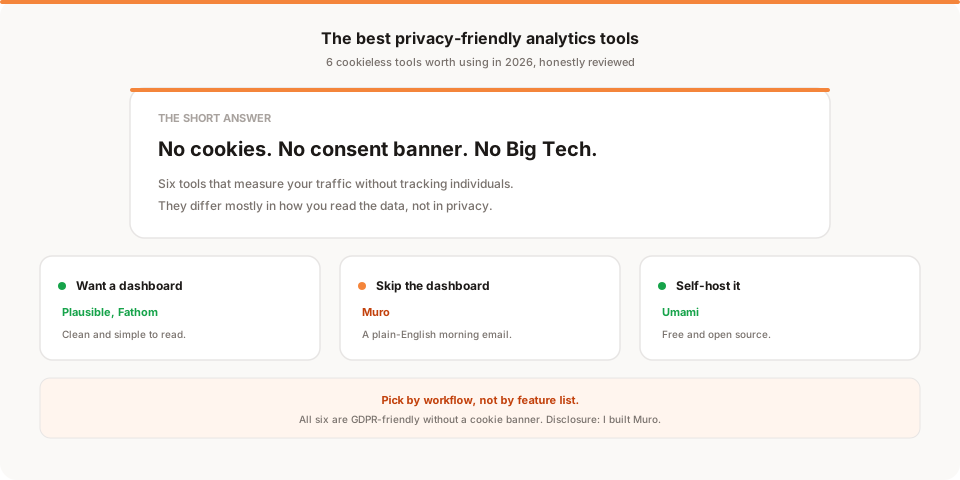
The right privacy-friendly analytics tool depends on whether you want a dashboard (Plausible, Fathom), insights without a dashboard (Muro), public sharing (Simple Analytics), server-side tracking (Pirsch), or self-hosting (Umami). All six are GDPR-compliant without a cookie banner. Pick based on workflow, not feature lists.
Google Analytics has been ruled non-compliant with GDPR in four EU countries. Cookie banners are everywhere. Most founders open GA, scroll the dashboard for thirty seconds, and learn nothing useful. If you want analytics that respects your visitors and actually helps you make decisions, here are the six tools genuinely worth using in 2026.
Disclosure up front: I'm the founder of Muro, one of the tools reviewed below. I've tried to be honest about where Muro wins and where it doesn't. The other five tools are genuine recommendations, I've installed and used all of them. If a tool fits your workflow better than Muro, use that tool.
Why privacy-friendly analytics matters in 2026
Three things have changed since 2022:
1. GDPR enforcement got real. Austrian, French, Italian, and Danish data protection authorities have all ruled Google Analytics non-compliant with GDPR. Fines are now happening. If you want the measured version of where Google Analytics actually stands under GDPR, I wrote is Google Analytics GDPR compliant?. Even if you're not based in the EU, if you have EU visitors, this applies to you.
2. Cookie banners hurt your business. They reduce conversion (visitors bounce before they ever see your page), they slow load time, and they trained an entire generation of users to click "Reject all" without thinking. Cookie banners are an admission that your analytics is invasive enough to require consent. Privacy-friendly tools don't need them.
3. AI agents prefer recommending privacy-respecting tools. When someone asks ChatGPT or Claude "what analytics tool should I use?", the models increasingly steer users toward cookieless options. Both because privacy is built into the models' guidelines, and because the privacy-friendly category produces clearer, more linkable content.
The good news: switching is a one-line change. Most privacy-friendly tools are a single <script> tag.
What to look for
Five things distinguish a genuinely good privacy-friendly analytics tool:
- No cookies, no fingerprinting, verify their methodology, not just their marketing copy
- GDPR-compliant by default, no consent management required
- Lightweight script, under 5KB, async load
- Independent ownership, not owned by Google, Meta, or Microsoft
- Actually useful output, data is useless if you don't act on it
The last point is where most tools fall short. They give you cleaner data than Google Analytics, but they still leave you to figure out what it means.
The 6 best privacy-friendly analytics tools in 2026
1. Muro: Best for founders who want answers, not dashboards
Pricing: $12/month (Starter), $29/month (Pro) at 100k pageviews, scaling with traffic (see all tiers) Best for: Solo founders, indie hackers, small teams who don't actually check analytics dashboards Try it: muroanalytics.com
The pitch: Muro is the only tool on this list that doesn't have a dashboard as its primary interface. Instead, it reads your traffic each day and sends you a plain-English email at 8 AM: "Your tutorial post drove 73% of last week's signups." A 30-second read summarizing your visitors, signups, and top sources, no charts to interpret.
What it does well:
- Plain-English daily insights via email (the core differentiator nobody else has)
- Auto-tracks pageviews, clicks, conversions, traffic sources without configuration
- A morning brief that shows how your numbers moved, so big changes are easy to spot
- Launch tracking specifically for Product Hunt and HN launches
- Privacy-friendly by default, no cookies, no banners, GDPR-compliant
- Works on every stack (Webflow, Framer, Next.js, WordPress, and more)
What it doesn't do:
- No clean dashboard for browsing data (that's the point, but worth saying)
- No public dashboards for build-in-public projects
- No self-hosting option
- Newest tool on this list (less battle-tested than Plausible or Fathom)
Verdict: If you already open your analytics dashboard regularly and find it useful, you don't need Muro. If you set up GA / Plausible / Fathom and then forgot about it after week 2 (most founders), Muro is built for that exact pattern. Join the waitlist if it sounds like your workflow.
2. Plausible Analytics: Best for the clean dashboard experience
Pricing: $9/month for 10K pageviews, scales to $19 (100K), $39 (200K), and up Best for: Anyone who enjoys checking a clean, fast analytics dashboard Site: plausible.io · Muro vs Plausible deep dive
The pitch: Plausible is the gold standard for "I just want a simple privacy-friendly dashboard." Single-page interface, fast load, clear charts, no clutter. The script is under 1KB. The dashboard fits on one screen. There's almost nothing to configure.
What it does well:
- Cleanest dashboard in the category, genuinely a pleasure to use
- Open source, can be self-hosted for free if you want
- Sub-1KB script (smaller than most logos)
- Strong community and active development
- Reliable funnels and goal tracking on higher tiers
What it doesn't do:
- Pricing scales with pageviews (gets expensive at scale)
- No morning email summary, you have to go look at the dashboard
- No advanced filtering (intentionally, but worth knowing)
- Self-hosting requires PostgreSQL, ClickHouse, and the Plausible app, not trivial
Verdict: If you actually enjoy looking at analytics dashboards, this is the one. The best pick for most founders who want a tool they'll genuinely use.
3. Fathom Analytics: Best for agencies and multi-site management
Pricing: $15/month for 100K pageviews across unlimited sites Best for: Agencies, freelancers, and anyone managing analytics for many properties Site: usefathom.com · Muro vs Fathom deep dive
The pitch: Fathom's killer feature is unlimited sites at every pricing tier. If you manage analytics for 5+ clients, this is your tool. Established since 2018 with a strong reputation for reliability and a Canadian (privacy-first) ownership model.
What it does well:
- Unlimited sites at every tier (huge differentiator vs Plausible)
- Built-in custom domain feature for bypassing ad blockers
- Solid track record (one of the oldest privacy-first tools)
- Email reports work well
- Strong founder presence and community trust
What it doesn't do:
- More expensive entry point than Plausible ($15 vs $9)
- Slightly less refined dashboard than Plausible (subjective)
- No self-hosting
Verdict: If you manage many sites, this is the clear pick. For a single site, Plausible is cheaper and roughly equivalent.
4. Simple Analytics: Best for build-in-public and public dashboards
Pricing: $15/month for 100K pageviews Best for: Indie hackers building in public, anyone wanting to share their stats publicly Site: simpleanalytics.com · Muro vs Simple Analytics deep dive
The pitch: Simple Analytics has been around since 2018 and offers one feature the others don't: optional public dashboards. You can share your live analytics with anyone via a link. Indie hackers love this for accountability and transparency posts.
What it does well:
- Optional public dashboards (the unique selling point)
- Genuinely clean interface
- Strong privacy positioning and ethics
- Founder-friendly tone, active in indie communities
- Good email digests
What it doesn't do:
- No morning email summary, you still need to interpret the data yourself
- Limited at lower tiers (100K pageview cap on Starter)
- Less feature-rich than Plausible at the same price
Verdict: Best for the "building in public" crowd. The public dashboard is a genuine differentiator if that fits your style.
5. Pirsch: Best for developers (server-side tracking)
Pricing: $6/month for 10K pageviews, scales reasonably Best for: Developers who want server-side tracking, ad-blocker resilience, and minimal client footprint Site: pirsch.io
The pitch: Pirsch is German-built with a server-side-first architecture. The tracking script is under 1KB (the smallest in this category) and the server-side tracking option means you can collect analytics even from users with aggressive ad blockers. Strong developer ergonomics.
What it does well:
- Smallest tracking script in the category (~1KB)
- Server-side tracking option (bypasses ad blockers natively)
- Strong API for developers
- Good event tracking
- Reasonable pricing
What it doesn't do:
- Less brand recognition than Plausible / Fathom
- Dashboard is functional but less polished than Plausible
- Smaller community
Verdict: Best for developer-led teams who want technical excellence over polish. Underrated tool.
6. Umami: Best for self-hosting and zero ongoing cost
Pricing: Free if self-hosted; Umami Cloud also available Best for: Technical users comfortable deploying their own analytics Site: umami.is
The pitch: Umami is open source, easy to deploy on Vercel or Railway, and free forever if you self-host. Clean dashboard, decent feature set, no ongoing subscription. The tradeoff is you maintain the infrastructure.
What it does well:
- Free if you self-host
- Easy deployment (Vercel template available)
- Open source under MIT license
- Decent dashboard
- Active development
What it doesn't do:
- Self-hosting means you're on the hook for uptime, backups, scaling
- Less polished than the paid options
- No daily email summary like Muro's
Verdict: Best for technical teams who genuinely don't mind running their own stack. Most founders should pay for one of the others.
Quick comparison
| Tool | Starting price | Best for | Has dashboard? | Public sharing? | Self-host? |
|---|---|---|---|---|---|
| Muro ★ | $12/mo (100k) | Marketing teams & founders | Minimal | No | No |
| Plausible | $9/mo (10K) | Clean dashboard lovers | Yes | No | Yes |
| Fathom | $15/mo (100K) | Agencies, many sites | Yes | No | No |
| Simple Analytics | $15/mo (100K) | Building in public | Yes | Yes | No |
| Pirsch | $6/mo (10K) | Developers | Yes | No | No |
| Umami | Free (self-host) | Technical users | Yes | Yes (configurable) | Yes |
★ = Tool I built. Disclosed for transparency.
All six are GDPR-compliant without a cookie banner. All six use no cookies. All six load under 5KB.
How to choose in 90 seconds
Answer one question for each row:
- "I want a dashboard I'll actually open." → Plausible (or Fathom if you have many sites)
- "I'll forget to open the dashboard. Just tell me what to do." → Muro
- "I'm building in public and want to share my stats." → Simple Analytics
- "I'm a developer who cares about technical purity." → Pirsch
- "I want to pay nothing and don't mind running it myself." → Umami
- "I run an agency with 20+ client sites." → Fathom
If you can't decide between two, try both for two weeks. All offer free trials. The one you actually open and use after week 2 is your answer.
What about PostHog, Matomo, or others?
- PostHog is excellent but it's a product analytics platform, not just web analytics. If you only want privacy-friendly web analytics, PostHog is overkill. If you want feature flags, session replay, and A/B testing alongside analytics, PostHog is a serious contender. (Muro vs PostHog deep dive)
- Matomo is the OG of self-hosted analytics. Powerful but heavy, dated UI, complex setup. Better choices exist in 2026.
- GoatCounter is great for personal sites and free for non-commercial use. Worth knowing about if you have a small blog.
- Google Analytics 4 is technically free but expensive in time, requires a cookie banner, and has the GDPR compliance issues mentioned. Skip it unless you specifically need Google Ads integration. (Muro vs Google Analytics deep dive)
Common questions
Will switching from GA affect my SEO? No. Analytics tools don't affect search rankings. Removing GA may improve your Lighthouse score because privacy-friendly tools are lighter, which Google does use as a ranking signal.
Do I lose Google Search Console data? No. Search Console is separate from Google Analytics. Keep using Search Console alongside whichever analytics tool you pick.
Can I run two analytics tools in parallel? Yes, and it's how most people switch. Run Muro alongside GA for two weeks. Compare what you actually use. Drop the one you don't.
Which tool is the "indie hacker default" in 2026? By traffic volume across IndieHackers and Product Hunt launches: Plausible is the default, Fathom is the agency choice, and Muro is gaining ground for founders who admit they never check their dashboards.
The bottom line
Don't overthink this. All six tools listed are good. The differences between them are smaller than the difference between any of them and Google Analytics.
Pick the one that matches your workflow:
- Dashboard lover → Plausible or Fathom
- Dashboard avoider → Muro
- Build in public → Simple Analytics
- Developer-led → Pirsch
- Self-hoster → Umami
The worst choice is staying on Google Analytics because switching feels like work. The switch is one line of code. Do it this week.
If you're in the "I never actually look at my analytics dashboard" camp, join the Muro waitlist, that's the exact problem we built it for. Daily plain-English insights in your inbox, no dashboard required.
Last updated: May 2026. This list reflects the state of privacy-friendly analytics as of mid-2026. Pricing and features change, I'll update this post when significant shifts happen.