Is Google Analytics GDPR Compliant in 2026? (An Honest Answer)
Google Analytics is not GDPR compliant out of the box. You can configure GA4 to reduce the risk, but it still uses cookies and generally needs a consent banner in the EU, and its history of EU to US data transfers has been legally contested. Cookieless, privacy-friendly analytics sidesteps most of that by not collecting personal data in the first place. This is general information, not legal advice.
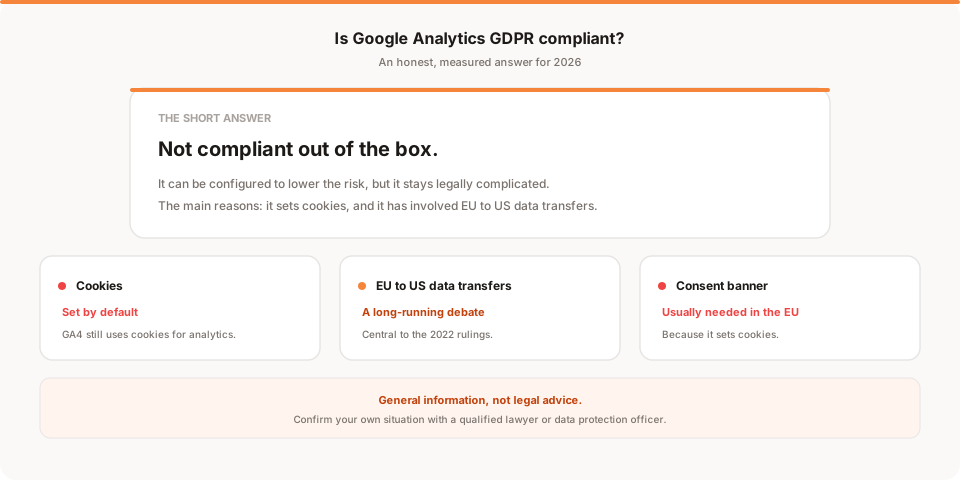
Short answer: no, not out of the box. Google Analytics can be configured to lower the risk, but it stays legally complicated, mainly because it sets cookies and has historically sent EU personal data to the US. This is an honest, measured look at where things stand in 2026, and what actually makes web analytics simpler under GDPR.
One important note before we start. I'm a founder, not a lawyer. Everything here is general information to help you understand the landscape, not legal advice. GDPR is genuinely nuanced, enforcement varies from country to country, and your situation may differ from the general case. For anything that matters, talk to a qualified lawyer or your data protection officer (DPO). I'll repeat that at the end, because it's the single most important line in this post.
Quick disclosure: I'm the founder of Muro, a privacy-friendly analytics tool. I've tried hard to keep this factual and balanced rather than turning it into a pitch. Muro shows up once, near the end, and I've kept the claims modest on purpose.
So, is Google Analytics GDPR compliant?
The most honest answer is: not on its own, and not by default.
Google Analytics can be set up in ways that reduce your legal exposure. But calling it "GDPR compliant" as if that's a fixed property of the product is misleading. Compliance depends on your configuration, your consent setup, where your visitors are, and how the underlying law is being interpreted at the time. Out of the box, GA4 sets cookies and processes data that can identify people, which is exactly the kind of processing GDPR is designed to govern.
So the useful framing isn't "is it compliant, yes or no." It's "how much work, risk, and ongoing attention does it take to use it responsibly under GDPR." For most small teams, the answer to that is: more than you'd expect, and more than you probably want.
Why is this even a question?
Because of two things that sit at the center of the debate: cookies and cross-border data transfers.
Google Analytics has traditionally set cookies in the visitor's browser and processed personal data such as IP addresses and identifiers. Under GDPR and the related ePrivacy rules, that generally puts it in the category of processing that needs a lawful basis and, for the cookies, consent.
The bigger and more contested issue has been data transfers. For years, using Google Analytics meant EU visitor data could be sent to servers in the US. After the Court of Justice of the European Union issued its 2020 ruling known as Schrems II, which raised the bar for transferring EU personal data to the US, this became a live legal problem.
Around 2022, several EU data protection authorities acted on it. Regulators in Austria, France, and Italy, among others, found that specific uses of Universal Analytics (the version of Google Analytics at the time) were unlawful, largely because of those EU to US transfers. These were decisions about particular cases and setups, not a blanket ban on the product, but they sent a clear signal across the EU. If you want the country-by-country version of that story, I broke it down in is Google Analytics illegal?.
Then the picture shifted again. In 2023, the EU adopted the EU-US Data Privacy Framework, which created a new legal basis for transferring data to certified US companies, Google included. That reduced the immediate transfer problem for many organizations. It did not fully settle the debate, though. Privacy advocates have questioned how durable the framework is and have signaled they may challenge it, much as earlier transfer arrangements were challenged and struck down.
I want to be careful here: this is context, not settled law. The framework is in force as I write this, and it genuinely changed the calculus. But "the transfer question is permanently solved" is not something anyone can honestly promise. If your comfort depends on that framework surviving, that's a risk worth understanding, and worth raising with a lawyer.
Did GA4 fix the GDPR problem?
Partly. GA4 changed some things, but it did not remove the core friction.
When Google moved everyone from Universal Analytics to GA4, it shipped some privacy-relevant defaults. GA4 anonymizes IP addresses by default and doesn't log or store full IP addresses the way older versions did. Google also added options for handling some EU data processing within the EU, plus consent-related controls like Consent Mode.
Those are real improvements. But GA4 still relies on cookies and consent for analytics in the EU. It's still a Google product operating inside Google's infrastructure, so the transfer questions above still apply at some level. And it still collects data that can count as personal data under GDPR.
So GA4 is a step forward on privacy compared to its predecessor. It is not a clean break from the reasons Google Analytics became a GDPR headache in the first place. You generally still need a consent banner, and you still need to configure it thoughtfully rather than trusting the defaults.
Do you need a consent banner for Google Analytics?
In most EU contexts, yes.
Because Google Analytics sets cookies and processes personal data, the usual reading is that you need a cookie consent banner and valid, freely given consent before it runs. That's not just a formality. Consent has to be a real choice, which means Analytics shouldn't load until the visitor agrees.
Consent banners carry a real cost beyond the legal box-ticking. They add friction to the first thing a visitor sees, they slow the page down slightly, and a large share of people click "reject" or ignore them, which means you lose that data anyway. So you end up with the compliance overhead of a banner and incomplete analytics as a result. For a lot of small sites, that's the worst of both worlds.
Rules and enforcement do vary by country, and there are edge cases, so this is another spot to confirm with a lawyer or DPO for your specific audience. But the general rule of thumb for GA in the EU is: assume you need consent, and design for it.
What actually makes analytics simpler under GDPR?
Here's the part that's genuinely clarifying: the easiest way to avoid most GDPR complexity is to collect less in the first place.
Most of the hard questions above (consent, cookies, transfers, lawful basis) exist because Google Analytics collects personal data. If a tool is built so that it doesn't collect personal data and doesn't set cookies, a lot of those questions simply don't arise. There's no consent to manage for cookies you never set, and far less transfer risk around data that was never personal to begin with.
That's the whole idea behind cookieless, privacy-friendly analytics. Tools in this category, including Plausible, Fathom, Simple Analytics, and Muro, are designed from the start to measure traffic in aggregate without tracking individuals. No cookies, no personal profiles, and in most EU contexts no consent banner required. I go deeper on the whole category in the best privacy-friendly analytics tools for 2026.
Two honest caveats. First, "no cookies, no personal data" reduces your GDPR surface area a lot, but it doesn't automatically make you compliant across everything your site does. Other scripts (chat widgets, ad pixels, embeds) can still set cookies. Second, each tool words its privacy claims a little differently, so read their documentation rather than taking a category label at face value.
GA4 vs privacy-friendly analytics, side by side
Here's how the two approaches compare on the dimensions that matter most for GDPR. Treat this as a general map, not a legal opinion, and remember that specifics depend on your exact configuration.
| Dimension | Google Analytics (GA4) | Privacy-friendly analytics |
|---|---|---|
| Cookies | Uses cookies by default | No cookies |
| Personal data | Processes identifiers such as IP-derived data | Aggregate, anonymized data |
| Consent banner | Generally needed in the EU | Generally not needed in most EU contexts |
| Data location | Google infrastructure, US transfer history | Often EU-hosted (varies by tool) |
| Setup complexity | Higher: tags, consent mode, configuration | Lower: one script, about 2 minutes |
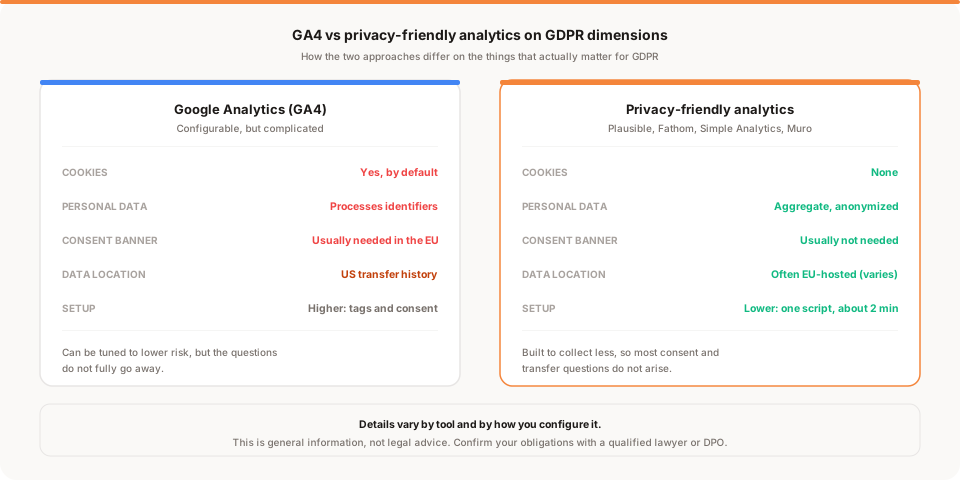
The pattern is consistent. GA4 can be tuned to lower risk, but the underlying questions never fully disappear. Privacy-friendly tools start from a place where most of those questions don't apply, because they were built to collect less. That's the real difference, and it's why so many founders find the switch simplifies their compliance thinking rather than just changing their dashboard.
If you're weighing that switch, the mechanics are less painful than they sound. I wrote a step-by-step on how to migrate from Google Analytics 4 that keeps GA4 running as a safety net while you test the replacement, so there's no risky cut-over.
What are the most GDPR-compliant analytics tools?
If you've decided the simplest path is to collect less, here are the privacy-friendly analytics tools most people move to. All are designed to be GDPR-friendly without a cookie banner in most EU contexts:
- Plausible: an open-source, EU-hosted dashboard, cookieless and lightweight.
- Fathom: a clean, simple dashboard with unlimited sites on every plan.
- Simple Analytics: a minimal dashboard with optional public stats.
- Muro: instead of a dashboard, a short plain-English brief emailed to your team each morning.
All four avoid cookies and, in most EU contexts, avoid the consent banner, because they don't collect personal data in the first place. That's the whole point: a GDPR-compliant analytics setup is far easier to reach when the tool was built to collect less than when it's one you have to configure your way toward. I go through the full category, including self-hosted options like Umami, in the best privacy-friendly analytics tools for 2026.
One honest note on the phrase itself: there is no official "GDPR-compliant" certification for an analytics tool, so treat the label as shorthand for "collects no personal data and needs no consent banner," not a legal guarantee. Your overall compliance still depends on every other script on your site.
Where does Muro fit?
Softly, and honestly: Muro is one of the privacy-friendly options above, built for founders who want the summary without the dashboard habit.
Muro uses no cookies, doesn't need a consent banner in most EU contexts, and is designed to be GDPR-friendly. Instead of tracking individuals, it summarizes your own aggregate data. Every morning at 8 AM it emails you a short, plain-English brief: how many visitors and signups you had, your top sources and top pages, and how the numbers moved compared to before. There's a full dashboard too, but most days the email is all you open. If you share links, Muro Links track any link you share right through to the signup in the same brief, and they're included on every plan. Pricing starts at $12 a month (Starter) at 100k pageviews and scales up with your traffic, with a Pro plan at $29 a month and unlimited team members, plus a 30-day free trial with no credit card.
I want to be clear about what Muro is and isn't, though. It summarizes what your own data shows. It does not offer legal advice, and choosing a cookieless tool is not, by itself, proof of compliance. It removes a big chunk of the GDPR complexity that comes with Google Analytics, but your obligations still depend on your whole site and your jurisdiction. If you want a fuller head-to-head on the two most common privacy-friendly picks, I compared them in Muro vs Plausible.
What should a small team actually do?
If you don't have a legal team on call, here's a sensible, low-drama way to approach it.
- Figure out what you're actually collecting. List every script on your site that sets cookies or sends data somewhere: analytics, ad pixels, chat widgets, embeds. GDPR cares about all of them, not just analytics.
- Decide whether you need GA at all. If you're not running Google Ads or deep ecommerce attribution, you may be carrying the GDPR cost of Google Analytics for data you never actually look at.
- If you keep GA, do the work properly. Set up consent correctly, keep the banner honest, and don't let Analytics load before the visitor agrees. Half-configured GA is the riskiest state to be in.
- If you switch, run both for a couple of weeks. Install a privacy-friendly tool alongside GA, compare the numbers so you trust the new one, then remove whichever you don't keep.
- When it carries real weight, ask a professional. For anything with legal consequences, a short conversation with a lawyer or DPO is a lot cheaper than a wrong guess.
None of this is complicated, but it's worth doing deliberately rather than leaving Google Analytics half-configured and hoping it's fine.
The honest bottom line
Google Analytics is not GDPR compliant out of the box. You can configure GA4 to reduce the risk, and the 2023 Data Privacy Framework helped on transfers, but it still uses cookies, still generally needs a consent banner in the EU, and still sits inside a legal debate that isn't fully settled. That's a lot of ongoing attention for a tool most founders barely check.
If GDPR simplicity is what you're after, the most reliable move is to collect less. Cookieless, privacy-friendly analytics tools were built for exactly that, and they remove most of the consent, cookie, and transfer questions before they start. That won't make you compliant on its own, but it meaningfully shrinks the surface area you have to worry about.
And to say it once more, plainly: this article is general information, not legal advice. GDPR is nuanced, it changes, and the right answer for your product depends on details I can't see from here. Before you make a decision that carries legal weight, talk to a qualified lawyer or your data protection officer.
If you'd like analytics that's privacy-friendly by default and lands as a two-minute email each morning instead of another dashboard to manage, try Muro free for 30 days. No credit card, no cookies, and about a two-minute setup. If a different privacy-friendly tool fits you better, use that one. The important step is getting off a setup that makes GDPR harder than it needs to be.