Muro vs Plausible: Which Privacy Analytics Tool Is Right for You? (2026)
Plausible and Muro share the same privacy-first, cookie-free foundation. The real choice is about format: Plausible is a clean dashboard you log into and read; Muro is a short email that lands in your inbox so you do not have to. Pick Plausible if you like checking a dashboard. Pick Muro if you would rather get the summary and move on.
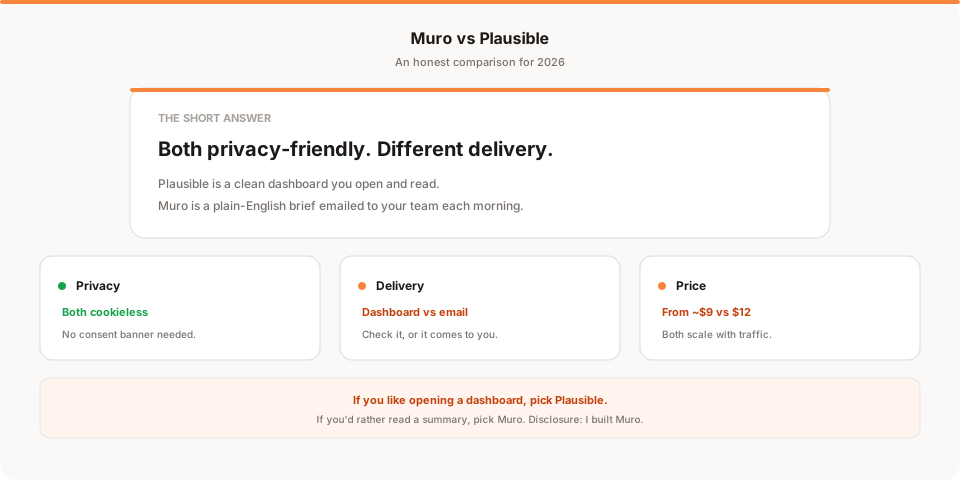
Plausible and Muro are both privacy-friendly, cookie-free analytics tools built as Google Analytics alternatives. They share the same values. The real difference is not features, it is format: Plausible is a dashboard you log into, and Muro is an email that comes to you. This is an honest comparison to help you pick the one that fits how you actually work.
Disclosure up front: I'm the founder of Muro, one of the two tools compared here. I use Plausible too, I respect it a lot, and I've tried to be fair about where it wins. If Plausible fits your workflow better after reading this, use Plausible. Both are good tools.
The short version
If you're in a hurry:
- Choose Plausible if you like opening a clean dashboard, want a mature and battle-tested tool, care about open source, or want to self-host.
- Choose Muro if you'd rather get a short email every morning than open a dashboard, want simple pricing as you grow, and want the links you share tracked in the same place.
They agree on the important stuff: both are privacy-friendly, cookie-free, GDPR-compliant, lightweight, and far simpler than GA4. You won't go wrong with either. The question is your habit, not the tooling.
What they have in common
It's worth being clear about this, because it's most of the picture. Muro and Plausible are more alike than different:
- No cookies, no consent banner. Both collect aggregate, anonymized data and don't need a GDPR cookie banner in most EU contexts.
- GDPR-compliant by default. Neither processes personal data the way GA4 does.
- Lightweight script. Both are tiny compared to GA4 plus Google Tag Manager. Your Lighthouse score improves either way.
- Two-minute setup. One script tag in your
<head>. No tag manager, no event configuration to get started. - Built as a GA4 alternative. Both exist because Google Analytics got too complex and too privacy-invasive for most site owners.
If your whole goal is "get off GA4 onto something private and simple," both tools accomplish that on day one. So the decision comes down to the part where they differ.
The real difference: a dashboard vs an email
Here's the one distinction that actually matters.
Plausible is a dashboard. You open it, and you get a single clean page: visitors over time, top sources, top pages, countries, devices. It's the antithesis of GA4's complexity, all on one screen. You read the charts and draw your own conclusions. It's genuinely well designed, and if you enjoy checking your stats, it's a pleasure to use.
Muro is an email. Every morning at 8 AM, you get a short summary in plain English: how many visitors and signups you had, where they came from, and how the numbers moved versus before. Most days you read it in two minutes and never open a dashboard at all. Muro does include a full dashboard, on par with Plausible's, for when you want to dig into something. It's just not how you use the product day to day. The email is.
That's the whole philosophical split. Plausible assumes you'll come to your analytics. Muro assumes you won't, and brings the summary to you.
Neither is right or wrong. It depends entirely on one honest question about yourself.
So which are you?
Be honest about your actual behavior, not your aspirational behavior.
You're a Plausible person if:
- You genuinely open your analytics and find it useful when you do.
- You like reading charts and spotting patterns yourself.
- You want to watch live traffic during a launch.
- You value open source and the option to self-host.
- You want public, shareable dashboards.
You're a Muro person if:
- You set up analytics and then mostly forgot to check it.
- You'd rather read a two-minute email than log into a tool.
- You want the numbers that matter pushed to you, not pulled by you.
- You'd rather spend that time building or talking to users.
- You want the links you share tracked alongside your site traffic.
A lot of founders install a dashboard with good intentions and then never open it. If that's you, a dashboard, even one as nice as Plausible's, is solving a problem you don't have. An email might fit your real habits better.
Where Plausible is the stronger choice
I want to be straight about this, because it's a real list.
- It's mature. Plausible has been around since 2018, is profitable and independent, and is trusted by thousands of companies. Muro is much newer and less battle-tested.
- It's open source. You can read the code, contribute, and self-host it for free if you're willing to run it. Muro is closed-source and cloud-only.
- Self-hosting. If you want full data ownership on your own servers, Plausible supports that. Muro does not.
- Public dashboards. Plausible lets you make your stats public, which is great for building in public. Muro doesn't offer this.
- Smaller script. Plausible's script is under 1KB; Muro's is under 5KB. Both are tiny, but Plausible wins the technical purity contest.
If any of those matter to you, Plausible is the honest recommendation.
Where Muro is the stronger choice
And the other side:
- You get both. Muro includes a clean dashboard on par with Plausible's and the daily email. So you can dig into the data when you want to, but you don't have to, because the email covers most days. With Plausible, the dashboard is all there is.
- You don't have to open it. The daily email means most days you get what you need without logging into anything. For founders who never check their dashboard anyway, this is the whole point.
- Simple pricing. Muro is $12 a month for Starter and $29 for Pro at 100k pageviews, and both scale up with your traffic. Plausible starts at $9 for 10,000 pageviews and scales with traffic. Muro includes unlimited team members on every plan.
- Plain English, not charts. The summary is written in sentences, not graphs you have to interpret. If "is a 34% bounce rate good?" is the kind of question that stalls you, a written summary helps.
- Muro Links built in. With Muro you can turn any URL into a short, trackable link and see how it performed right alongside your site traffic, and it's included on every plan. Plausible doesn't bundle link shortening.
Pricing, head to head
| Muro | Plausible | |
|---|---|---|
| Starting price | $12/month (Starter, 100k) | $9/month (10K pageviews) |
| Model | Scales with pageviews (Starter, Pro) | Tiered, scales with traffic |
| Team members | Unlimited on every plan | Unlimited |
| Self-host (free) | No | Yes |
| Free trial | 30 days, no card | 30 days, no card |
For a tiny site, Plausible's $9 entry is a touch cheaper. Muro's $12 Starter starts at 100k pageviews and scales up with your traffic, as does the $29 Pro plan, and both include unlimited team members. Compare on fit and how you like to work, not a couple of dollars.
How to actually decide (in 60 seconds)
- Think about the last month. Did you open your analytics dashboard and act on what you saw? If yes, you're a dashboard person: go with Plausible.
- If you mostly didn't open it, ask whether you'd read a two-minute email about it instead. If yes, go with Muro.
- If you care about open source or self-hosting, that's Plausible, full stop.
- If you want simple pricing as you scale and link tracking in one place, that's Muro.
You can also just try both. Both have a 30-day free trial with no credit card, and both install in two minutes. Run them side by side for a week and notice which one you actually use. Your behavior will tell you the answer faster than any comparison post can.
What neither tool is built for
To keep this honest, here is where both Muro and Plausible will let you down, so you know before you switch.
Neither is a deep product-analytics tool. If you need event funnels across dozens of custom events, cohort retention curves, or session replay, you are looking for something like Mixpanel or PostHog, not a lightweight web analytics tool. Both Muro and Plausible focus on traffic and conversions, not granular in-app behavior.
Neither replaces Google Ads attribution. If your growth runs on paid search and you need to optimize bids against conversion data inside the Google ecosystem, GA4's native integration still matters, and neither tool tries to compete there.
And neither gives you raw, warehouse-scale data export the way GA4's free BigQuery pipe does. For most small teams that is a feature they never touched, but if you genuinely pipe analytics into a data warehouse, factor it in. If any of these are core to your work, the honest move is to keep GA4 or add a product-analytics tool rather than force a lightweight one to do a job it was not built for. I compared the wider field in the best Google Analytics alternatives.
Why your numbers will look different from GA4
One thing surprises almost everyone who switches to either tool: the visitor counts often come in higher than GA4 showed, not lower.
That is not a bug, and it is not the new tool inflating numbers. GA4 needs consent in the EU, so every visitor who rejects or ignores your cookie banner is missing from its reports. Muro and Plausible collect no personal data and need no banner, so they count those visitors by default. The result is a fuller picture of your real traffic.
You will also see small differences between Muro and Plausible themselves, because every analytics tool defines a "visit" and filters bots slightly differently. Do not expect two tools to match to the visitor. Pick one as your source of truth and watch the trend inside it, rather than trying to reconcile exact numbers across tools.
Switching between them, or from GA4
Because both install as a single script, moving is low-stakes.
The safe pattern is to run the new tool in parallel with whatever you have now, GA4 included, for two or three weeks. You get both sets of numbers, you learn to trust the new one, and nothing is lost if you change your mind. When you are confident, remove the old script and you are done.
The one caveat is history: there is no automated way to import past data between Muro, Plausible, and GA4. Each tool starts counting the day you install it. In practice this matters far less than it sounds, because most small teams rarely look at data older than a month. If you want the full step-by-step, including keeping GA4 as a read-only backup, I wrote how to migrate from Google Analytics 4.
Can you just use both?
A few people run Plausible and Muro together, and it is a legitimate setup. Plausible becomes the dashboard you open when you want to slice something in detail, and Muro becomes the morning email that means you rarely need to. Because both are cookieless and lightweight, running the two scripts side by side adds negligible weight and no consent-banner burden.
It is more than most small teams need, and paying for two tools to cover one job is usually overkill. But if you genuinely want both a deep dashboard and a hands-off summary, nothing stops you. For most people the honest move is simpler: pick the one that matches your habit and commit to it.
The bottom line
Plausible is an excellent, mature, privacy-first dashboard, and it's the right call for anyone who genuinely uses a dashboard. I recommend it without hesitation to that person.
Muro is for the other person: the founder who installed analytics, meant to check it, and quietly never did. Instead of a dashboard you feel guilty about ignoring, you get a short email each morning and the rest of your time back.
Same privacy values. Same simplicity. Different delivery. Pick the one that matches how you actually work.
If you think you're the email person, try Muro free for 30 days. No credit card, two-minute setup, and your first summary lands the next morning. If it turns out you're a dashboard person after all, Plausible will be right there, and it's a great choice too.