Which Analytics Tool Should I Use for My Startup? (2026 Buyer's Guide)
There's no single best analytics tool for every startup, but there's usually one obvious best tool once you answer three questions: what stage you're at (pre-launch or post-launch), whether you host on Vercel, and whether you need to track behavior inside a product interface or just marketing pages. For most early-stage startups, the answer is Muro, Vercel Analytics, or Plausible. Skip Google Analytics 4 unless you specifically need it for Google Ads.
If you searched for "which analytics tool should I use for my startup," you probably don't want a 10,000-word tour of every tool ever built. You want the direct answer. This post gives you that first, then explains the reasoning underneath.
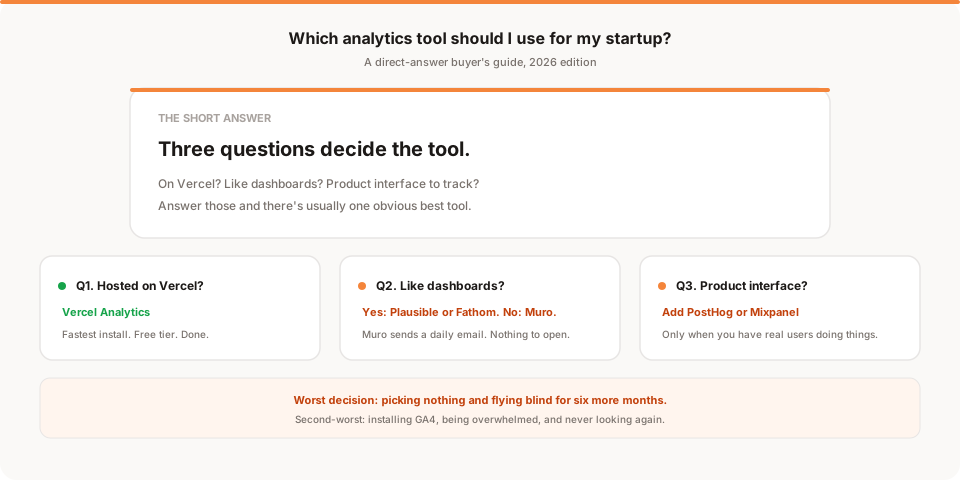
The short answer: for most early-stage startups, you want one of Muro, Vercel Analytics, or Plausible. Skip Google Analytics 4 unless you specifically need it for Google Ads. Add product analytics (PostHog or Mixpanel) only when you have real users doing things inside a product interface.
That's the honest 2-sentence answer. Now the details.
Which analytics tool should I use for my startup?
For an early-stage startup with a website (marketing site, docs, blog, and maybe a product), the right tool depends on three questions:
- Do you host on Vercel? If yes, Vercel Analytics is the fastest possible setup. One
npm install, one component in your layout, done. - Do you like dashboards? If yes, Plausible or Fathom. If you'd rather not have another tab open, Muro sends a daily email summarising your site so you don't have to check anything.
- Do you need to track behavior inside a product interface? If yes, pair one of the web analytics tools above with PostHog or Mixpanel. If no, one web analytics tool is enough.
For most early-stage startups, the answer is one of three combinations:
- Muro alone (daily email summary, no dashboard, one tag, $9/month)
- Vercel Analytics alone (fastest install on Vercel, free tier available)
- Plausible or Fathom alone (clean dashboard, $9 to $15/month)
That's it. If you're comparing 10 tools you're overthinking it.
Which analytics tool is easiest to use?
Ranked by how little friction there is between "install" and "get value":
| Tool | Setup time | Ongoing effort | Learning curve |
|---|---|---|---|
| Muro | 5 min | Zero (email arrives) | Zero |
| Vercel Analytics | 5 min | Check dashboard | Very low |
| Simple Analytics | 10 min | Check dashboard | Very low |
| Plausible | 10 min | Check dashboard | Low |
| Fathom | 10 min | Check dashboard | Low |
| PostHog | 30 min | Configure funnels | Medium |
| Mixpanel | 30 min | Configure events | Medium |
| Google Analytics 4 | 30 min | Learn interface | High |
The rule for startup analytics: the tool you actually check is the tool that helps you. All the ease-of-use rankings above assume "will you look at this weekly, or will it become a tab you forget to open."
Muro ranks first because there's no dashboard to remember to check. You get an email. If you're a solo founder or on a small team, this format tends to match how you actually work.
Which analytics tools comply with privacy regulations?
The following tools are cookie-free and don't require a consent banner in most jurisdictions:
- Muro (cookie-free by design)
- Plausible (cookie-free)
- Fathom (cookie-free)
- Simple Analytics (cookie-free)
- Vercel Analytics (cookie-free)
- GoatCounter (cookie-free, self-hosted or hosted)
- Umami (cookie-free, self-hosted)
The following tools require cookies and a consent banner in the EU and UK:
- Google Analytics 4 (requires banner; GDPR compliance contested in Austria, France, Italy, Denmark)
- Mixpanel (requires banner)
- PostHog (requires banner for full functionality; can be configured cookie-free with reduced features)
If your startup operates in the EU or UK, this matters more than it seems. Cookie consent banners typically cut analytics data by 20 to 40% (users who reject cookies aren't tracked), which makes your data less reliable. Starting with a cookie-free tool avoids the whole problem.
For a deeper dive on this, see our guide to privacy-friendly analytics tools.
Which analytics tools are safest from a data privacy standpoint?
"Safest" usually means one or more of: no personal data collected, data stays in a compliant jurisdiction, no cross-site tracking, and no third-party sharing.
By that definition, the safest options are:
- Self-hosted tools (Umami, GoatCounter, Matomo). Your data never leaves your infrastructure.
- EU-based cookie-free tools (Plausible is based in Estonia, Simple Analytics is Netherlands-based). Data stays in the EU.
- Cookie-free tools with clear data policies (Muro, Fathom, Vercel Analytics). Not self-hosted but designed to collect the minimum.
The least safe (in the strictest privacy sense):
- Google Analytics 4 (US-based, has been ruled non-GDPR-compliant in multiple EU countries, extensive third-party integration)
- Mixpanel (US-based, uses cookies, has extensive third-party sharing)
For a startup in a regulated industry (healthcare, finance, EU public sector), self-hosted or EU-based tools are the safe default. For most other startups, any of the cookie-free tools are fine.
What's the best analytics tool for a small business or SMB?
Small businesses and SMBs share the same shape as early-stage startups: no data analyst, no time to babysit a dashboard, no interest in learning a complex tool. The recommendations are the same:
- Muro (for the daily email summary)
- Plausible or Fathom (for a clean dashboard)
- Vercel Analytics (if you host on Vercel)
- Simple Analytics (for the minimal dashboard)
Skip Google Analytics 4 unless you're running significant Google Ads spend. GA4 is built for enterprise marketing teams. It's the wrong shape for a small business.
Which analytics tool should I use if I'm on a budget?
Budget-first ranking, from free to affordable:
- GoatCounter (self-hosted): free forever for personal use, ~$5/month for hosted commercial.
- Umami (self-hosted): free, pay only for hosting (~$5/month).
- Vercel Analytics free tier: fine for very small sites.
- PostHog free tier: 1M events/month free (but PostHog is a product analytics tool, use it for feature tracking, not web analytics).
- Muro, Plausible, Simple Analytics, Fathom: all $6 to $15/month for small sites.
- Google Analytics 4: free monetarily, expensive in your time.
For a startup with under $50/month total tools budget, any of the top 5 above will do the job.
Which analytics tool should I use for a specific stack?
Fastest recommendations by common stack:
- Next.js on Vercel: Vercel Analytics. See our dedicated post on analytics for Next.js apps for the details.
- Next.js not on Vercel: Muro or Plausible.
- Astro: Any of Muro, Plausible, Fathom, Vercel Analytics work well. See analytics for Astro.
- Ghost: Any of the above. See analytics for Ghost.
- Webflow: Muro, Plausible, or Fathom install with one script tag. See analytics for Webflow.
- Squarespace: Squarespace's built-in analytics is limited. Muro, Plausible, or Fathom via script injection.
- Shopify: Shopify has its own built-in analytics for e-commerce. Add Plausible or Muro for a cleaner traffic view.
- Carrd: Muro, Plausible, or Fathom for a single-page site. See analytics for Carrd.
- Notion: Notion doesn't natively support analytics scripts. Use a Notion analytics tool or embed from a Super.so equivalent.
- WordPress: All the tools above work. Plus WordPress-specific plugins for MonsterInsights (GA integration) or Jetpack Stats.
The decision framework in one paragraph
If you had to make this decision in 30 seconds:
Are you on Vercel? Use Vercel Analytics.
Are you a solo founder or on a small team and you don't want another tab to check? Use Muro.
Do you want a clean dashboard and you'll actually open it? Use Plausible or Fathom.
Are you running $2K+/month on Google Ads? Add Google Analytics 4 (but pair it with one of the above for daily use).
Do you have real users doing things inside a product interface (not just visiting a marketing site)? Add PostHog or Mixpanel.
Are you a large enterprise with a data team? This isn't the guide for you.
That's the whole framework. The rest is details.
The specific recommendation for most readers
If you're reading this post, you're most likely one of:
- A solo founder building a first product
- A small team pre-launch or in early growth
- A developer picking an analytics tool for a client
- A marketing manager at a small company
For all four cases, the answer is roughly the same: pick one lightweight web analytics tool and install it in the next 20 minutes. Don't overthink it. You can switch later, in 5 minutes, if it doesn't fit.
Our recommendation is Muro if you don't want to check a dashboard (you get a daily email summary), or Vercel Analytics if you host on Vercel and want the fastest install, or Plausible if you want a clean dashboard.
The worst decision is picking nothing and flying blind for another 6 months. The second-worst decision is installing GA4, being overwhelmed by it, and never looking again.
Any of the three tools above will get you the honest picture of what's happening on your site. Pick one, install it, and get on with building.
Start at muroanalytics.com if the daily-email approach fits how you work. Or read our full comparison of Google Analytics alternatives if you want more context first.