10 Best Google Analytics Alternatives in 2026 (Free + Paid)
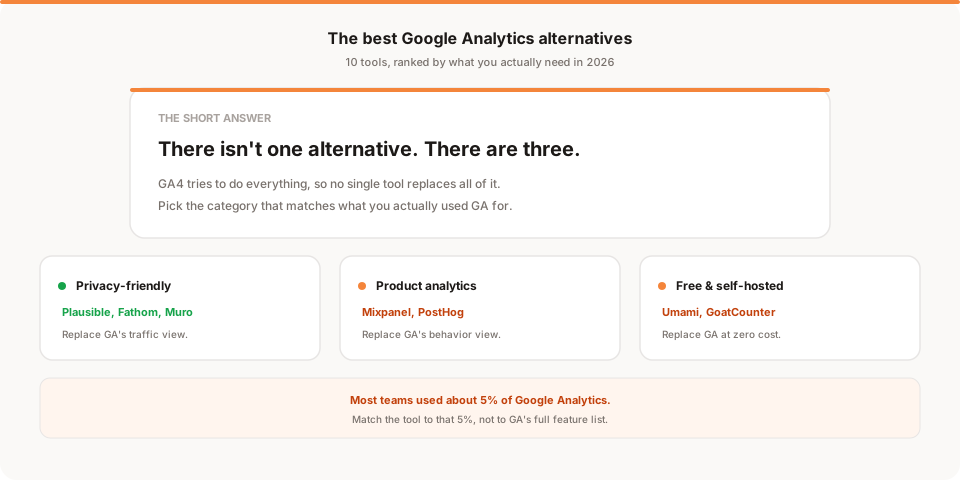
There isn't one Google Analytics alternative, there are three categories. Privacy-friendly web analytics (Plausible, Fathom, Muro, Simple Analytics, Pirsch, Umami) replace GA's traffic features. Product analytics (Mixpanel, PostHog) replace GA's user-behavior features. Pick based on what you actually used GA for, most teams used 5% of it.
Google Analytics is free, ubiquitous, and increasingly avoided. GA4 has been ruled non-GDPR-compliant in four EU countries, and it is not GDPR compliant out of the box even where it has not been challenged. Cookie banners are mandatory in the EU. The interface is genuinely hard. And honestly, most teams only used about 5% of GA4 anyway. Here are the ten alternatives actually worth switching to in 2026, across web analytics, privacy-friendly tools, enterprise self-hosted, and product analytics.
Disclosure up front: I'm the founder of Muro, one of the tools reviewed below. I've tried to be honest about where Muro wins and where it doesn't. The other seven tools are genuine recommendations, I've installed and used all of them. If a tool fits your workflow better than Muro, use that tool.
Why people are leaving Google Analytics in 2026
Four reasons, in roughly the order they matter:
1. GA4 is genuinely hard to use. The 2023 migration from Universal Analytics broke most workflows. The new interface is denser than the old one. Most founders open GA4, scroll for thirty seconds, and learn nothing useful. Switching to almost any alternative gives you a more useful tool, immediately.
2. GDPR compliance is now actively enforced. Austrian, French, Italian, and Danish data protection authorities have ruled GA4 non-compliant. Fines have happened. If you have EU visitors, this applies to you regardless of where you're based.
3. Cookie banners hurt your business. GA4 requires consent banners in the EU. Banners reduce conversion (visitors bounce before they see the page), they slow load time, and they trained an entire generation of users to click "Reject all" without thinking.
4. Privacy-friendly tools load faster. GA4 + Google Tag Manager is typically 80KB or more. Privacy-friendly alternatives are usually under 5KB (Pirsch and Plausible are under 1KB). Lighthouse scores improve immediately when you switch.
The good news: switching is a one-line code change. Most alternatives are a single <script> tag.
What you actually lose when leaving GA4
Honest answer: less than you think.
- Google Ads attribution becomes harder. Matters if you run serious paid acquisition through Google Ads. If you don't, skip this concern entirely.
- Custom reporting and exploration interfaces disappear. Most teams never used these.
- BigQuery and Looker Studio integration goes. Mostly relevant for enterprise data teams.
For 90% of small-to-mid teams, you lose nothing you actually used.
What you gain
- A tool you'll actually open. All alternatives have cleaner UIs than GA4.
- Faster page loads. Under 5KB scripts instead of 80KB+.
- No cookie banner needed. For privacy-friendly tools.
- GDPR compliance by default. For privacy-friendly tools.
- Less time wasted. GA4 takes hours to configure properly. Alternatives take minutes.
The 10 best Google Analytics alternatives in 2026
The right alternative depends on what part of GA4 you were actually using. Three categories:
- Web traffic analytics (pageviews, sources, conversions): Plausible, Fathom, Muro, Simple Analytics, Pirsch, Matomo, GoatCounter, Umami
- Product analytics (in-app behavior, retention, funnels): Mixpanel, PostHog
- Both at once: PostHog (heavy but capable), Matomo (1:1 GA4 replacement), or run two tools
1. Muro: Best for founders who never actually open analytics dashboards
Pricing: $12/month (Starter), $29/month (Pro) at 100k pageviews, scaling with traffic (all tiers) Category: Web analytics Best for: Solo founders, indie hackers, small teams who installed GA4 and then forgot it existed Try it: muroanalytics.com · Muro vs Google Analytics
The pitch: Muro is the only alternative on this list that doesn't have a dashboard as its primary interface. Instead, it reads your traffic each day and sends you a plain-English email at 8 AM: "Your tutorial post drove 73% of last week's signups." A 30-second read summarizing your visitors, signups, and top sources, no charts to interpret. Built for the exact group of people who opened GA4 once and never went back.
What you get vs GA4:
- Plain-English daily insights via email (GA4 has no equivalent)
- 2-minute setup vs hours of GA4 configuration
- No cookie banner, no consent management
- 5KB script vs 80KB+ for GA4 + GTM
- Auto-tracks pageviews, clicks, conversions without event configuration
- Works on every stack (Webflow, Framer, Next.js, WordPress)
What you don't get:
- Email-first by design (there is a dashboard, but it is not the main event)
- No Google Ads integration
- Newest tool on this list (less battle-tested than Plausible / Fathom)
Verdict: If you set up GA4 and then never opened it again (most founders), Muro is built for exactly that pattern.
2. Plausible Analytics: Best for the clean dashboard replacement
Pricing: $9/month for 10K pageviews, scales to $19 (100K), $39 (200K) Category: Web analytics Best for: Anyone who actually used GA4's dashboard and wants a cleaner version of the same thing Try it: plausible.io · Muro vs Plausible
The pitch: Plausible is the most common direct GA4 replacement. Single-page dashboard, under 1KB script, no cookie banner, open source (self-hostable if you want). The dashboard fits on one screen, the antithesis of GA4's complexity.
What you get vs GA4:
- 99% smaller script (1KB vs 80KB+)
- 90% less complexity (one page vs 50)
- No cookie banner
- GDPR compliant by default
- Optional self-hosting
What you don't get:
- No advanced exploration interfaces
- Pricing scales with pageviews (gets expensive at scale)
- No morning email summary, you still have to interpret the data
Verdict: The default pick for "I want GA4 but better." If you actually use a dashboard, start here.
3. Fathom Analytics: Best for agencies and multi-site management
Pricing: $15/month for 100K pageviews across unlimited sites Category: Web analytics Best for: Agencies, freelancers, anyone running 5+ properties Try it: usefathom.com · Muro vs Fathom
The pitch: Fathom's superpower is unlimited sites at every pricing tier. If you manage analytics for clients or run multiple side projects, this is the obvious switch. Established since 2018 with a Canadian privacy-first ownership model.
What you get vs GA4:
- Unlimited sites at every tier
- Built-in custom domain for bypassing ad blockers
- 7-year track record (one of the oldest privacy-first tools)
- Solid email reports
- Strong founder presence in indie communities
What you don't get:
- Single-site users overpay vs Plausible ($15 vs $9 starting)
- Slightly less refined dashboard than Plausible
- No self-hosting option
Verdict: If you manage many sites, this is the clear pick over Plausible. For one site, Plausible is cheaper.
4. Mixpanel: Best for product analytics (replacing GA4 events)
Pricing: Free up to 1M events/month, then $28/month and up Category: Product analytics Best for: SaaS teams who used GA4 for in-app event tracking Try it: mixpanel.com · Muro vs Mixpanel
The pitch: If you used GA4 mainly for tracking in-product behavior (signups, feature usage, retention), Mixpanel is the dedicated replacement. Way more powerful than GA4 for product analytics, with cohort analysis, funnels, retention curves, and proper user-level tracking.
What you get vs GA4:
- Significantly better product analytics depth
- Real cohort analysis (GA4's is weak)
- Retention curves that actually work
- User-level identified tracking
- Generous free tier (1M events/month)
What you don't get:
- Not a web analytics replacement (no traffic source reports, etc.)
- Steeper learning curve than privacy-friendly tools
- Per-event pricing scales fast at high volume
- Uses cookies and identifiers (may need consent management)
Verdict: For SaaS product teams who need real product analytics, this is the strongest GA4 alternative. Pair it with a privacy-friendly tool for marketing-site analytics.
5. PostHog: Best all-in-one GA4 replacement
Pricing: Free up to 1M events/month, then pay-as-you-go per product Category: All-in-one platform Best for: Teams who want analytics + feature flags + session replay + A/B testing in one tool Try it: posthog.com · Muro vs PostHog
The pitch: PostHog is the closest thing to a true all-in-one GA4 replacement. Web analytics, product analytics, session replay, feature flags, A/B testing, surveys, all in one open-source tool. If GA4 was the "Swiss Army knife you couldn't figure out", PostHog is the Swiss Army knife that actually works.
What you get vs GA4:
- Genuine all-in-one platform (analytics + flags + replay + tests + surveys)
- Open source, self-host for free if you want
- Generous free tier (1M events/month)
- Strong API and developer ergonomics
- Cohort analysis that works
What you don't get:
- Complexity (you're learning a platform, not just analytics)
- Pricing complexity (per product, scales fast)
- Heavyweight for teams who only need web analytics
Verdict: Best if you'd otherwise need multiple SaaS subscriptions. Overkill if you just want web analytics.
6. Simple Analytics: Best for build-in-public and public dashboards
Pricing: $15/month for 100K pageviews Category: Web analytics Best for: Indie hackers sharing stats publicly, transparency-focused founders Try it: simpleanalytics.com · Muro vs Simple Analytics
The pitch: Simple Analytics has been around since 2018 and offers one feature the others don't: optional public dashboards. You can share your live analytics with anyone via a link. Indie hackers love this for accountability and transparency posts.
What you get vs GA4:
- Optional public dashboards (the unique feature)
- Clean interface, strong privacy positioning
- Founder-friendly tone, active in indie communities
What you don't get:
- No morning email summary
- Limited at lower tiers
- Less feature-rich than Plausible at the same price
Verdict: Best for the "building in public" crowd.
7. Pirsch: Best for developers leaving GA4
Pricing: $6/month for 10K pageviews Category: Web analytics Best for: Developer-led teams wanting server-side tracking and minimal client footprint Try it: pirsch.io
The pitch: Pirsch is German-built with a server-side-first architecture. The tracking script is under 1KB. The server-side tracking option means you can collect analytics even from users with aggressive ad blockers, which kills GA4's data accuracy.
What you get vs GA4:
- Smallest tracking script available
- Server-side tracking option (bypasses ad blockers natively)
- Strong developer ergonomics and API
- Reasonable starting price ($12/month)
What you don't get:
- Less brand recognition than Plausible/Fathom
- Dashboard is functional but less polished
- Smaller community
Verdict: Underrated. Best for developer-led teams who care about technical purity.
8. Matomo: Best enterprise-grade self-hosted GA4 alternative
Pricing: Free (self-hosted) or from €23/month (Matomo Cloud, hosted in Germany) Category: Web analytics Best for: Teams needing full data ownership, EU governments, regulated industries, anyone replacing GA4 at scale Try it: matomo.org
The pitch: Matomo is the oldest serious GA4 alternative, running since 2007 (formerly Piwik). It's the only tool on this list with near-feature parity for everything GA4 does in a single install: goal tracking, e-commerce, custom events, heatmaps (paid add-on), session recordings (paid add-on), A/B testing. If you actually used the depth of GA4 and want self-hostable plus GDPR-compliant, this is the no-compromise option.
What you get vs GA4:
- Near-feature parity with GA4 in one tool
- Full data ownership when self-hosted
- EU-hosted cloud option (Matomo Cloud lives in Germany)
- Goal funnels, e-commerce reporting, A/B testing add-ons
- Trusted by the European Commission, NASA, the UN
- Open source under GPL v3
What you don't get:
- Lightweight setup. Matomo is heavier than every other tool on this list.
- A modern dashboard. The UI feels like 2015 GA next to Plausible or Fathom.
- Cheap add-ons. Price and complexity ramp fast once you turn on heatmaps and session recording.
Verdict: If you need a true 1:1 GA4 replacement and value data ownership, Matomo is the no-compromise option. For most indies and solo founders, this is overkill, pick Plausible, Fathom, or Muro instead.
9. Umami: Best free GA4 alternative (self-hosted)
Pricing: Free if self-hosted; Umami Cloud also available Category: Web analytics Best for: Technical users comfortable deploying their own analytics Try it: umami.is
The pitch: Umami is open source, easy to deploy on Vercel or Railway, and free forever if you self-host. Clean dashboard, decent feature set, no ongoing subscription. Closest thing to "GA4 but free, simple, and yours."
What you get vs GA4:
- Free forever (self-hosted)
- Easy deployment (Vercel template available)
- Open source under MIT license
- Decent dashboard
What you don't get:
- Self-hosting means you're on the hook for uptime, backups, scaling
- Less polished than the paid options
- No daily email summary like Muro's
Verdict: Best for technical teams who don't mind running their own stack.
10. GoatCounter: Best free hosted GA4 alternative (no self-hosting required)
Pricing: Free for non-commercial and personal use (hosted); donation-supported; self-hostable for free too Category: Web analytics Best for: Personal sites, blogs, side projects, and anyone who wants free hosted analytics without deploying their own stack Try it: goatcounter.com
The pitch: GoatCounter is the rare alternative that's genuinely free and hosted, you don't have to run a server like you do with Umami or self-hosted Matomo. It's open source, privacy-friendly by default (no cookies, no personal data, GDPR-compliant), and one of the most minimal tools on this list. Built and maintained by a solo developer, funded by donations and paid commercial plans.
What you get vs GA4:
- Genuinely free hosted tier (not a trial) for personal and non-commercial use
- No cookies, no consent banner, GDPR-compliant by default
- Tiny tracking script
- Open source, self-hostable if you prefer
- Refreshingly simple, single-page dashboard
What you don't get:
- Commercial use requires a paid plan or self-hosting
- Bare-bones feature set (no funnels, no product analytics, no morning email summary)
- Solo-maintained, so support and roadmap move at one person's pace
Verdict: Best for personal sites, blogs, and side projects that want free hosted analytics with zero infrastructure. For a business you actively monetize, pick a paid web analytics tool like Muro, Plausible, or Fathom.
Quick comparison table
| Tool | Category | Starting price | Replaces GA4 for | Has dashboard? |
|---|---|---|---|---|
| Muro ★ | Web | $12/mo (100k) | Daily brief email, plus a dashboard | Minimal |
| Plausible | Web | $9/mo (10K) | Clean dashboard replacement | Yes |
| Fathom | Web | $15/mo (100K) | Multi-site / agencies | Yes |
| Mixpanel | Product | Free → $28/mo | Product event tracking | Yes |
| PostHog | All-in-one | Free → pay-as-you-go | Analytics + flags + replay + tests | Yes |
| Simple Analytics | Web | $15/mo (100K) | Public dashboards | Yes |
| Pirsch | Web (dev) | $6/mo (10K) | Server-side tracking | Yes |
| Matomo | Web (enterprise) | Free → €23/mo | 1:1 GA4 replacement, self-hostable | Yes |
| Umami | Web (free) | Free (self-host) | Free open-source alternative | Yes |
| GoatCounter | Web (free) | Free (hosted, non-commercial) | Free hosted, no self-hosting | Yes |
★ = Tool I built. Disclosed for transparency.
How to choose in 90 seconds
By workflow:
- "I never opened GA4 anyway." → Muro (insight emails, no dashboard)
- "I want a cleaner version of GA4's dashboard." → Plausible
- "I run an agency with many client sites." → Fathom
- "I used GA4 mainly for product/event tracking." → Mixpanel
- "I want analytics + feature flags + replay + tests in one tool." → PostHog
- "I'm building in public and want to share stats." → Simple Analytics
- "I'm a developer who wants server-side tracking." → Pirsch
- "I need a true 1:1 GA4 replacement at scale." → Matomo
- "I want to self-host for free." → Umami
- "I want free hosted analytics for a personal site or blog." → GoatCounter
How to actually migrate from GA4 (30 minutes total)
The "migration" is honestly simpler than people think:
- Pick one alternative from the list above (60 seconds, using the decision tree).
- Install the script tag, usually a single
<script>in your<head>. Most alternatives provide step-by-step instructions per platform. - Leave GA4 running in parallel for 2-3 weeks. Both tools collect data. You compare.
- Confirm the new tool answers your real questions. If yes, proceed. If no, try a different alternative (you've lost nothing).
- Remove the GA4 tag and Google Tag Manager from your site. Your Lighthouse score will jump.
- Take down your cookie banner if GA was your only reason for needing it.
What you don't do: try to import historical GA4 data. You can't, and you don't need to, nobody looks at analytics data older than 30 days anyway.
The bottom line
Don't overthink this.
If you used GA4 for web analytics (pageviews, sources, conversions, basic events), switch to Plausible, Fathom, or Muro, depending on whether you want a dashboard, multi-site support, or insight emails.
If you used GA4 for product analytics (in-app events, retention, funnels), switch to Mixpanel or PostHog.
If you used GA4 for both at the same time (and most teams that did this used 5% of either), run two tools, one privacy-friendly web analytics + one product analytics tool. That's how most modern SaaS teams set up in 2026.
The worst choice is staying on GA4 because switching feels like work. The switch takes 30 minutes. Do it this week.
If you fall into the "I installed GA4 and never actually opened it" camp, and statistically most founders do, join the Muro waitlist. That's the exact problem Muro was built to solve. Daily plain-English insights in your inbox, no dashboard to forget.
Last updated: June 2026. Matomo and GoatCounter added, bringing the list to ten. This list reflects the state of GA4 alternatives as of mid-2026. Pricing and features change, I'll update this post when significant shifts happen.