Which traffic source converts best? A practical guide for founders
The best traffic source is not the one that sends the most visitors. It is the one with the highest conversion rate and strongest activation signal.
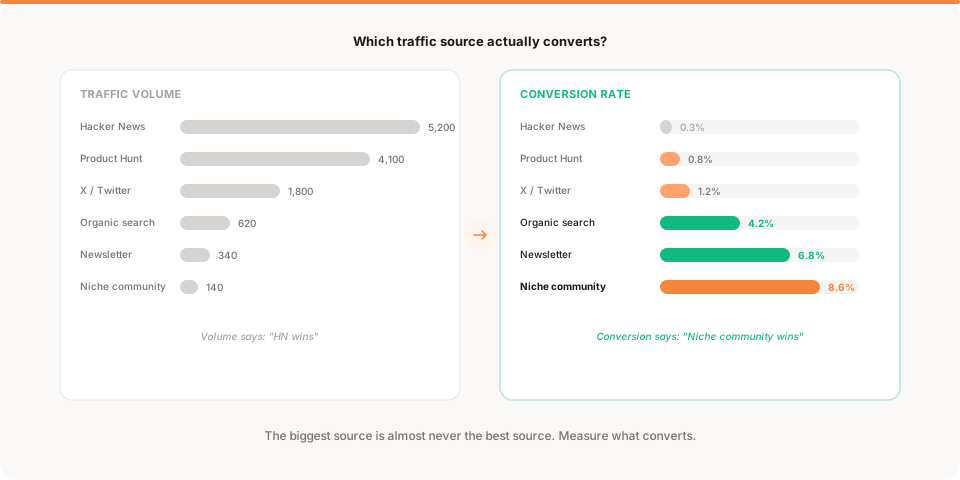
You launched on Product Hunt and got 4,000 visitors. You posted a Twitter thread and got 1,800 more. Someone shared your product in a niche Slack group and 140 people clicked through.
Your analytics dashboard shows the total: 5,940 visitors in a week. It looks amazing.
But when you check signups, you have 42. That is a 0.7% conversion rate across all sources.
The instinct is to think your landing page needs work. But that instinct is wrong.
If you break those 42 signups down by source, the picture changes completely:
- Product Hunt: 4,000 visitors, 12 signups (0.3%)
- Twitter: 1,800 visitors, 9 signups (0.5%)
- Niche Slack group: 140 visitors, 12 signups (8.6%)
The smallest source produced the same number of signups as the largest one. And it did it with 97% fewer visitors.
Your landing page is fine. Your traffic quality is the variable. And most founders never look at it this way.
Why volume is misleading
When founders check their analytics, they almost always look at total traffic first. Which source sent the most visitors? That feels like the important question.
But total traffic tells you about attention, not about fit. A source that sends 5,000 curious browsers is worth less than one that sends 200 people who are actively looking for what you built.
This is the most common analytics blind spot. You see the big number, feel good about it, and then wonder why signups are not growing proportionally. The answer is almost always that the big number is coming from the wrong place.
First, make sure you can see source data at all
Everything below assumes your analytics can actually tell one source from another. For a lot of founders it cannot, because every link they shared was the same bare URL, so the tool files most of the traffic under "direct" and the breakdown becomes impossible.
Fixing that takes two things. First, put UTM parameters on every link you control. A UTM is just a tag added to the end of a URL (utm_source, utm_medium, utm_campaign) that tells your analytics where the click came from. Give each channel its own tagged link: one for the Product Hunt page, one for the launch tweet, one for the newsletter, one for each community. Now a click from your tweet shows up as Twitter instead of blurring into "direct."
Second, lean on referrer data for everything you did not tag. When someone clicks a link to your site from another page, the browser usually passes along where they came from, and good analytics tools record it. Between tagged links and referrers, you can attribute the large majority of your traffic.
Do this before your next launch, not after. Source attribution is one of the few things you genuinely cannot reconstruct later: if the links went out untagged and the launch is over, that data is simply gone. Tag first, launch second.
How to actually compare traffic sources
The right way to evaluate a traffic source is not by how many visitors it sends. It is by what those visitors do after they arrive.
Step 1: Break down conversion rate by source
This is the single most important analysis you can run on your traffic.
For each source, calculate: signups / visitors from that source.
You will almost always find that the ranking by conversion rate is the opposite of the ranking by volume. The source with the most visitors converts the worst, and the source with the fewest converts the best.
Step 2: Check activation rate by source
Conversion is not enough. You also want to know whether the signups from each source actually use the product.
If 100 people sign up from Twitter but only 5 complete onboarding, that is a 5% activation rate. If 12 people sign up from a niche community and 9 complete onboarding, that is a 75% activation rate.
The community source is not just converting better. It is producing better users.
Step 3: Look at cost per acquisition
If you spend time or money on a channel, factor that in.
Writing a Twitter thread takes 2 hours. Managing a Product Hunt launch takes a full day. Posting in a niche community takes 15 minutes.
If all three produce roughly the same number of signups, the community post has the highest return on your time by a massive margin.
Most founders do not think about time as a cost. But when you are a solo founder with 8 hours in a day, time is your scarcest resource. The channel that converts with the least effort is the one you should double down on.
Source-by-source breakdown
Here is what to expect from the most common traffic sources, based on patterns that show up across small products.
Organic search
Organic search traffic is often your best-converting source because visitors have active intent. They searched for something related to your product. They want a solution.
Typical conversion rate: 3% to 8%
The downside: organic traffic grows slowly. It takes weeks or months of content and SEO effort before you see meaningful volume. But it compounds. A blog post that ranks today will send traffic for years.
If organic is converting well, invest in more content. This is the most sustainable growth channel for most small products.
Email and newsletters
If you have an existing email list, it is almost always your highest-converting channel. These are people who already know you, opted in, and chose to receive updates.
Typical conversion rate: 5% to 15%
The upside: high intent, high trust, high activation. The downside: limited by list size. You cannot scale a newsletter overnight.
If email converts well, grow the list. Offer a lead magnet, add signup forms to your blog, or cross-promote in communities.
Niche communities
Small, focused communities (Slack groups, Discord servers, niche subreddits, industry forums) often convert surprisingly well because the audience is pre-qualified.
Typical conversion rate: 3% to 10%
The key is relevance. A developer tool shared in a developer Slack group converts much better than the same tool shared on a general tech forum.
The downside: volume is small. But if you can find 5 to 10 relevant communities and contribute genuinely, the cumulative conversion can outperform a Product Hunt launch.
Twitter / X
Twitter traffic is unpredictable. A thread can get 10 likes or 10,000. The conversion rate varies wildly depending on how well your audience matches your followers.
Typical conversion rate: 0.3% to 2%
The pattern: big spikes, fast decay, low conversion. Twitter is better for awareness and brand building than for direct acquisition. If you see conversion above 1%, your audience is well-matched. If it is below 0.5%, the followers are curious but not buyers.
Product Hunt
Product Hunt sends a lot of traffic. The conversion rate is usually low because the audience is browsing, not buying.
Typical conversion rate: 0.3% to 1.5%
Product Hunt is valuable for social proof, backlinks, and initial awareness. But it is rarely your best acquisition channel. If you measure launch success properly, you will usually find that the signups from Product Hunt activate at a lower rate than signups from organic or email.
Reddit and Hacker News
These platforms can send enormous traffic spikes. Conversion rates are typically low because the audience is broad and curiosity-driven.
Typical conversion rate: 0.1% to 1%
Hacker News can send 10,000 visitors in a day. If 20 of them sign up, that is a 0.2% conversion rate. Impressive volume, but the per-visitor value is low. The traffic spike pattern almost always applies here.
The mistakes founders make
Mistake 1: Optimizing for the biggest source
If Product Hunt sent 5,000 visitors and a Slack group sent 150, the instinct is to invest more in Product Hunt. But if the Slack group converted at 8% and Product Hunt at 0.3%, the Slack group produced more signups with a fraction of the effort.
Optimize for conversion rate, not traffic rank.
Mistake 2: Judging all sources by the same standard
A 1% conversion rate from Twitter is very different from a 1% conversion rate from organic search. Twitter traffic is passive (they saw something in their feed). Organic traffic is active (they searched for something). Same rate, completely different intent and retention profile.
Compare sources to themselves over time, not to each other on a flat scale.
Mistake 3: Not checking activation
A source that converts at 3% but activates at 10% is worse than a source that converts at 1.5% but activates at 60%. The second source produces fewer signups but more actual users.
If you only look at signup rate, you miss this. Always check what happens after signup.
Mistake 4: Spreading too thin
Trying to be active on Twitter, Product Hunt, Reddit, three Slack groups, a newsletter, and SEO at the same time is a recipe for doing nothing well.
Find one or two channels that convert. Go deep. Add more channels only after the first ones are producing consistent results.
A simple framework for deciding where to focus
Answer these three questions for each traffic source:
1. What is the conversion rate? How many visitors from this source actually sign up?
2. What is the activation rate? Of those who sign up, how many complete the first meaningful action?
3. What is the effort cost? How much time or money does it take to maintain this channel?
Rank your sources by conversion rate multiplied by activation rate, divided by effort. The source with the highest score is where you should spend more time.
You do not need a spreadsheet for this. You need five numbers and one decision.
A worked example: where month-two effort should go
Say it is a month after launch and you have four channels with real data:
- Product Hunt: 4,000 visitors, 0.3% conversion, 20% activation, one full day of effort
- Twitter: 1,800 visitors, 0.5% conversion, 25% activation, a few hours a week
- A niche subreddit: 300 visitors, 6% conversion, 65% activation, 30 minutes a week
- Your newsletter: 400 visitors, 9% conversion, 70% activation, one email
Rank these the naive way, by traffic, and Product Hunt wins in a landslide. Rank them the way that matters, by conversion times activation against the effort they cost, and the order flips completely. The subreddit and the newsletter are producing the most real, activated users for the least time, while Product Hunt is eating a full day to deliver a handful of tourists.
The month-two decision then writes itself. Stop treating Product Hunt as a growth channel and file it under one-off awareness. Put the time you reclaim into the newsletter and that subreddit: grow the list, find three or four more communities like that one, and go deep. You are not adding channels, you are moving effort from the channel that looks impressive to the ones that actually compound. That single reallocation, made from data rather than vibes, is usually worth more than any landing-page tweak.
Start with what converts, not what looks impressive
The founder who sends 100 targeted visitors from a niche community and gets 8 signups is growing faster than the founder who gets 10,000 visitors from Hacker News and gets 15 signups.
The first founder knows exactly where their users come from, what resonates with them, and how to reach more of them. The second founder has a traffic chart that looks great and a user base that barely grew.
Traffic is not growth. Converting traffic is growth. And the only way to know which source converts is to measure each one separately, honestly, and regularly.
Keep reading
- How to measure product launch success: evaluate launches by outcome, not by buzz
- Traffic is up but conversions are down: diagnose the most common traffic quality problem
- The 5 metrics that actually matter: what to watch after you find your best channel
- Muro for builders: real-time source tracking with conversion breakdowns