Why users don't come back (and how to fix retention early)
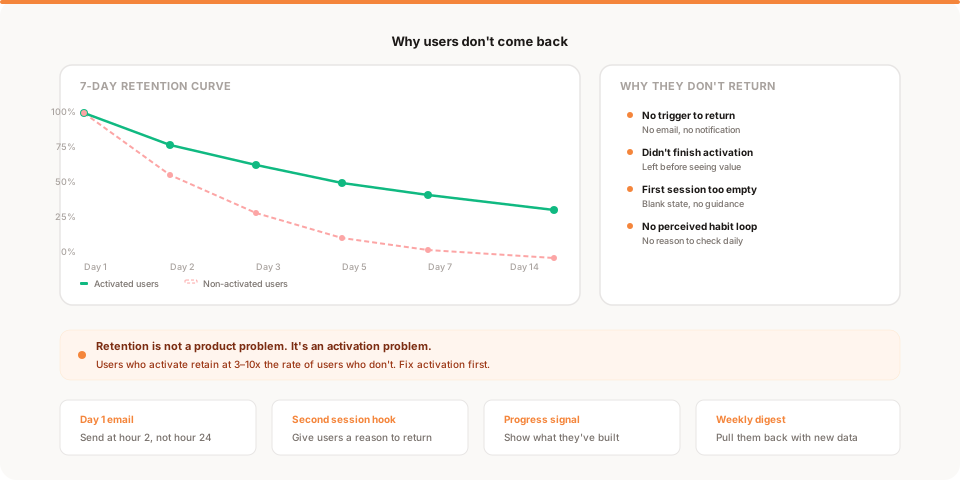
Most early churn is not a product quality problem. It is an activation and re-engagement problem. Users who experience value in session one return. Users who don't, almost never do.
100 users signed up this month. You check your analytics two weeks later. 12 are still active.
That is 88% churn in two weeks. And the hard part is not the number. The hard part is that most of those 88 users did not decide your product was bad. They just drifted away.
They were busy. They forgot. They never got a reason to come back. And by the time you noticed they were gone, it was too late.
This is early retention: the window from signup to habit, and why most products lose the majority of users before they ever form one.
Why retention matters more than you think right now
Most founders in the first three to six months are focused on acquisition. Traffic, conversions, signups. These are the numbers that feel like progress.
But without retention, acquisition is a treadmill. You need new users every month just to maintain the same active user count. The more users you add and lose, the more you need to add. The math never gets easier.
Retention is the multiplier. A product that retains 40% of users grows from the same acquisition budget twice as fast as a product that retains 20%. And at some retention level, you start compounding: users who stay long enough begin referring others, upgrading, and expanding their usage.
Activation rate is the metric that predicts retention. But retention rate is what tells you whether your product is building lasting value or just satisfying temporary curiosity.
The two types of retention failure
Not all churn is the same. Before you can fix it, you need to know which type you have.
Type 1: Pre-activation churn
The user signed up but never experienced the product's core value. They created an account, looked around, and left before they understood what the product was for.
This is the most common type of early churn and the most fixable. The user did not leave because they disliked the product. They left because they never got to the part where the product is useful. How quickly that useful part arrives matters as much as whether it arrives at all. Time to first value covers how to measure and shorten that window.
Signs of pre-activation churn:
- Low activation rate (below 30%)
- Most churn happens in the first 24 to 48 hours
- Users who do come back are the ones who completed onboarding
Type 2: Post-activation churn
The user activated. They completed the first meaningful action. They understood the product. And then they still did not come back.
This is harder to fix because it usually means the product is not giving users a sustained reason to return. There is no pull. The habit loop never formed.
Signs of post-activation churn:
- Decent activation rate but low 7-day retention among activated users
- Users return once or twice but not regularly
- Engagement peaks in the first session and declines
The fixes for each type are completely different. Diagnosing which you have is the first step.
How to measure your retention rate
You do not need a sophisticated analytics setup for this. You need two numbers and a time window.
The basic calculation
Day-7 retention rate = users who return within 7 days of signup / total new signups in the same period
If 100 users signed up last week and 22 of them visited the product again within 7 days, your day-7 retention is 22%.
You can also calculate:
- Day-1 retention: returned within 24 hours
- Day-14 retention: returned within 2 weeks
- Day-30 retention: returned within a month
Start with day-7. It is the most commonly tracked, easy to calculate, and gives you a fast feedback loop on changes you make.
Segment by activation
The most useful thing you can do beyond calculating the overall rate is split it by activated versus non-activated users:
- What is the day-7 retention for users who completed the activation event?
- What is the day-7 retention for users who did not?
If activated users retain at 45% but non-activated users retain at 6%, you do not have a product problem. You have an activation problem. Getting more users through the activation step will fix your retention.
If activated users retain at only 12%, the product itself needs attention. The value is not sticky enough to create a return habit.
This single segmentation tells you where to spend your energy.
The 5 reasons users don't come back
Once you know your retention numbers, these are the root causes to investigate.
1. There is no trigger to return
This is the most common cause of early churn, and the most overlooked.
The user signed up. They spent 20 minutes in your product. They closed the tab. And then nothing happened.
No email. No notification. No reason to open the product again.
For most products, if you do not actively pull users back in the first 48 hours, you will not see them again. Not because they disliked the experience. Because their attention moved to the next thing.
The fix is a re-engagement trigger. Not a newsletter. Not a promotional email. A specific, relevant nudge that gives the user a reason to open the product right now.
For an analytics tool, that might be: "Your first data just came in." For a project management app: "You left a task incomplete yesterday." For a note-taking app: "Here is your weekly summary."
The trigger should be personal, timely, and actionable.
2. The first session ended before value was delivered
The user ran out of time or motivation before they reached the part of the product that makes it worthwhile.
This is closely related to signup completion problems, but it extends further. The user may have completed signup and even started onboarding, but left before they hit the moment that would have made them want to come back.
For an analytics tool, this might mean they added the tracking code but left before they saw any data. For a CRM, they imported contacts but never sent their first email. For a landing page builder, they started a page but did not publish it.
They got close. But "close" does not create a return habit.
The fix: shorten the path to the moment of value. Whatever your activation event is, design the onboarding to reach that event in the fewest possible steps. Every step that happens before value is delivered is a risk of losing the user before they have a reason to return.
3. The product showed an empty state
They signed up. They completed setup. They landed in your product. And they saw nothing.
Empty dashboards. Placeholder cards. "No data yet." Waiting for the first integration to complete. Waiting for first-day traffic to accumulate.
Empty states are retention killers. When a user sees nothing in a product, they conclude (often incorrectly) that the product is not ready or not useful for them. They do not think "I should come back when there's data." They think "this does not work" and they leave.
The fix: never show an empty product. Use sample data. Show a demo view. Pre-populate with placeholder content that illustrates what the product looks like when active. Make the product feel alive from the first second.
A user who sees a full, populated dashboard on their first visit will return to see their own data fill in over time. A user who sees nothing will not.
4. The product does not have a natural return cadence
Some products have obvious daily or weekly use cases. Email. Messaging. Project management. Analytics (if it surfaces new insights regularly). These products have built-in reasons to return.
Other products solve a problem that users have occasionally. They are not sure when or why they should open the product again. And without a clear reason, they do not.
If your product does not naturally generate a return trigger, you need to create one. This means building a cadence into the product or communication:
- A weekly email digest with data or insights
- A daily notification when something changes
- A weekly summary sent even when the user has not logged in
- A reminder when something they care about needs attention
The goal is to make your product part of a routine. Not by being annoying. By being useful at a regular interval.
5. The value did not match the expectation
The user signed up because of what the landing page promised. The product delivered something slightly different.
Not bad. Not broken. Just not exactly what they expected.
This gap between promise and delivery is subtle and hard to diagnose, but it shows up in the data. Users activate, explore, and then stop returning. When you talk to them, they often say something like "it wasn't quite what I was looking for" or "I thought it would be more..."
The fix requires honest alignment work. Read your landing page copy. Then use the product as a new user. Is the first experience consistent with the promise? Does the product do what the marketing says it does in the way users expect?
If there is a gap, either change the product to match the promise or change the promise to match the product. Either direction works. What does not work is the gap itself.
The early retention playbook
If your day-7 retention is below 25%, this is the sequence that typically produces the fastest improvement.
Week 1: Fix the activation funnel
Before you worry about re-engagement, make sure users are reaching activation in the first place. Check your activation rate. If it is below 30%, that is the source of most of your churn.
The specific fixes depend on your product, but the framework is always:
- Reduce onboarding steps
- Remove the empty state
- Give users one clear action to take
Week 2: Add a day-1 re-engagement email
Set up an automated email that goes out 1 to 2 hours after signup (not the next day, this is too late for most users). The email should:
- Reference something specific to where the user is in the product
- Give them one clear reason to come back right now
- Link directly to the relevant page, not the homepage
Something like: "You created your account 2 hours ago. Your first report is ready, click here to see it." This is dramatically more effective than "Welcome to ProductName! Here's everything you can do."
Week 3: Create a weekly value touchpoint
Whatever your product does, send a weekly email that delivers the core value in the email itself. Analytics tools send a weekly summary. Writing tools send a streak reminder. CRMs surface tasks that need attention.
The goal is to make the user feel the product's value without requiring them to open it. This sounds counterintuitive, but it works: a user who gets value from your weekly email will open the product to act on it more often than a user who gets a generic "haven't seen you in a while" nudge.
Week 4: Talk to churned users
Pick 10 users who signed up, activated at least once, and have not returned in 2 weeks. Email them directly:
"You signed up for ProductName two weeks ago and used it briefly. I'm trying to understand what didn't stick. Would you be willing to tell me in one sentence why you stopped using it?"
You will get responses from 20% to 40% of them. These responses will tell you more about your retention problem than any dashboard.
What retention looks like when you fix it
Most early-stage products that improve their retention from 10% to 35% day-7 do it with three changes:
- They shorten the path to activation
- They add a timely day-1 re-engagement email
- They eliminate the empty state on first visit
None of these require new features. All three are changes to the onboarding and communication layer.
The product itself is usually fine. The problem is that users leave before they see what makes it good.
The longer view
Early retention is the foundation of everything else. It determines whether your acquisition efforts compound or evaporate. It determines whether word-of-mouth grows your product or whether every user you gain is offset by a user you lose.
The five metrics that actually matter for small products all depend on retention in one way or another. Activation feeds retention. Retention feeds revenue. Revenue funds acquisition.
Improving day-7 retention from 10% to 30% is the highest-leverage growth change most early products can make. And unlike SEO or paid acquisition, it compounds: every user you keep is a user who might tell someone else.
Start with the numbers. Find out which type of churn you have. Then work backward to the specific step where users are drifting away.
The users who signed up wanted your product. Most of them are not lost because they changed their mind. They are lost because you have not yet given them a reason to stay.
Keep reading
- What is user activation: the metric that predicts whether users will return
- Why users don't complete signup: fixing the funnel before the retention window
- The 5 metrics that actually matter: where retention fits in the full picture
- Muro for founders: see how Muro surfaces retention signals automatically