The best Pirsch alternatives in 2026 (an honest comparison)
The best Pirsch alternative depends on why you're leaving. Plausible is the closest like-for-like swap with a cleaner dashboard and a free self-hosted edition. Fathom suits people with many sites, Umami and Matomo suit people who want to self-host, and Muro suits teams who want a short plain-English brief every morning on top of a dashboard. If you rely on Pirsch's server-side tracking or its low price at 10k pageviews, staying on Pirsch is often the right call.
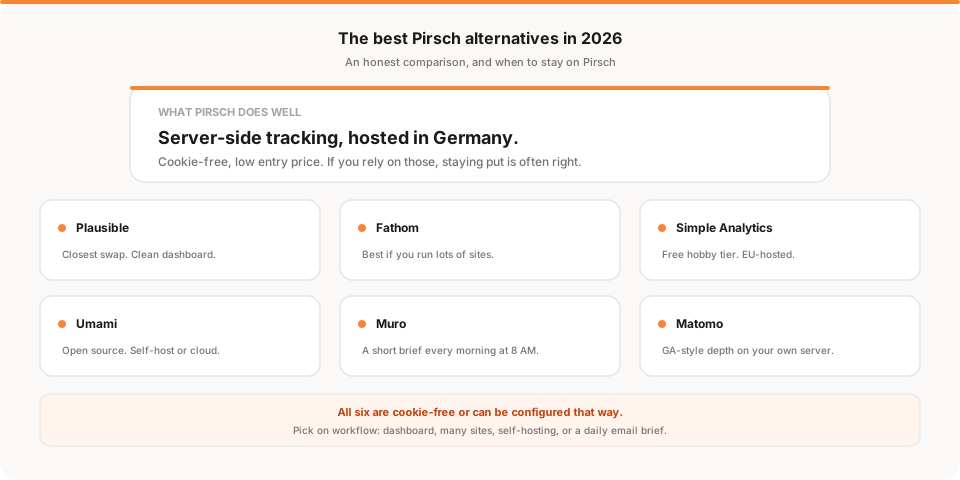
Short answer: the best Pirsch alternative for most people is Plausible, which is the closest like-for-like swap. Pick Fathom if you run many sites, Umami or Matomo if you want to self-host, and Muro if you want a short plain-English brief every morning on top of a dashboard. If you depend on Pirsch's server-side tracking, staying put is often the smart move.
Disclosure: I'm Sanjeeva, and I build Muro, one of the tools on this list. So weigh my take on Muro accordingly. I've tried to be fair to Pirsch and to everyone else, and I'll tell you when Muro is the wrong pick.
Competitor prices below are approximate and taken from each tool's pricing page in November 2026. They change often, so check their site before you decide.
What Pirsch does well
Pirsch is a German, cookie-free web analytics tool, and it's a good one. Before you look elsewhere, it's worth being clear about what you'd be giving up.
- Server-side tracking. This is the big one. Pirsch lets you send pageviews from your backend through its API instead of a browser script, and its docs call this the recommended approach because the browser can't block it. Few tools in this category treat server-side tracking as a first-class option.
- Cookie-free by design. Pirsch builds a visitor ID by hashing the IP address, user agent, date and a per-site salt. Its privacy policy says the IP is never stored, and visitors can't be recognized for more than 24 hours.
- Hosted in Germany. All data sits on a server cluster in Germany, which matters if your legal or procurement team wants EU-only hosting.
- A real API and integrations. There's a REST API with SDKs, plus integrations for WordPress, Webflow, Framer, Shopify, Astro, Laravel, Google Tag Manager and more. It can also import data from Google Analytics, Plausible and Fathom.
- Low entry price. Pirsch Standard started around $6 a month for 10,000 pageviews and about $12 for 100,000. That's cheaper than most tools here at small volumes.
- More features than you'd expect. Standard includes events and goals, session analysis, a URL shortener, email reports, up to 50 websites and unlimited members. Plus (about $12 a month at 10,000 pageviews) adds funnels, A/B testing and segmentation, unlimited websites, custom domains and white labeling.
- A 30-day free trial with no card.
If that list covers everything you need, you may not need an alternative at all. More on that below.
Why people look for a Pirsch alternative
The reasons I hear most often are about fit, not quality:
- They want a bigger ecosystem. Plausible and Fathom have larger user bases, more third-party guides, and more people who can answer a question in a forum.
- They want to self-host. Pirsch's on-premise option sits in its Enterprise tier. If you want to run analytics on your own server for free, Umami, Plausible Community Edition or Matomo fit better.
- They want a different dashboard. Pirsch packs in a lot: sessions, funnels, tags, A/B segments. Some people want fewer panels, not more.
- Their team doesn't open the dashboard. This is a workflow problem, not a Pirsch problem. Every dashboard tool, Pirsch included, depends on someone remembering to log in.
- Price at their volume. Pirsch is cheap at the low end, but funnels and unlimited sites need Plus, and custom events count toward your monthly pageview limit. Run the numbers at your real traffic.
The best Pirsch alternatives at a glance
| Tool | Price from (approx., Nov 2026) | Cookie-free | Self-host option | API | Standout |
|---|---|---|---|---|---|
| Pirsch (for reference) | ~$6/mo (10k), ~$12/mo (100k) | Yes | Enterprise on-premise | Yes | Server-side tracking, hosted in Germany |
| Plausible | ~$9/mo (10k), ~$19/mo (100k) | Yes | Yes, free Community Edition | Stats API on Business plan | Cleanest dashboard, open source |
| Fathom | ~$15/mo (100k) | Yes | No | Yes, all plans | 50 sites included, long track record |
| Simple Analytics | Free hobby plan; paid ~$20/mo | Yes | No | Yes (check plan) | Free tier, EU-hosted |
| Umami | Free to self-host; Cloud free tier, Pro ~$20/mo | Yes | Yes | Yes (Cloud Pro and up) | Open source, cheap to run |
| Muro ★ | $12/mo (100k) | Yes | No | Links only (Pro) | Plain-English brief every morning |
| Matomo | Free to self-host; Cloud ~€29/mo | Can be configured | Yes | Yes | Deepest feature set, GA-style |
★ = the tool I build.
1. Plausible: the closest like-for-like swap
Price (approx., check their site): Starter from about $9 a month for 10,000 pageviews and about $19 for 100,000. Growth and Business cost more at each tier.
Plausible is the tool most Pirsch users end up comparing against, because the two are so similar: cookie-free, EU-hosted, a lightweight script, a simple dashboard. Plausible says its script is 54 times smaller than Google Analytics, and its dashboard fits on one screen.
Why it fits: you get a cleaner, calmer dashboard, a large user base, and open source code. If you ever want to leave the cloud, the self-hosted Community Edition is free (with some features held back, like funnels and revenue goals).
The trade-off vs Pirsch: it costs more at small volumes, Starter covers one site only, and funnels, revenue and the Stats API need the Business plan. Server-side tracking is possible through its Events API but isn't the headline feature it is at Pirsch.
Best for: people who want the same privacy story with a simpler dashboard and a bigger community. I go deeper in Muro vs Plausible.
2. Fathom: best if you run lots of sites
Price (approx., check their site): from about $15 a month for 100,000 pageviews, with at least 50 sites on every plan.
Fathom has been around since 2018 and has a strong reputation for reliability. Every plan includes the Analytics API, unlimited email reports, and at least 50 sites, which makes it popular with agencies and freelancers.
Why it fits: a polished, stable product with an EU isolation option and a pricing model that doesn't punish you for adding sites. Fathom also says it won't switch off analytics over an occasional traffic spike.
The trade-off vs Pirsch: no self-hosting, a higher entry price for small sites, and a 7-day trial that needs a card (you aren't charged until it ends).
Best for: agencies and anyone managing many client sites. See Muro vs Fathom.
3. Simple Analytics: best if you want a free tier
Price (approx., check their site): a free plan for hobby sites (1 user, 5 websites, 1 month of history, a badge required), then a self-serve plan from about $20 a month starting at 100,000 pageviews.
Simple Analytics is an EU-hosted tool (its primary infrastructure is in the Netherlands) with a strong privacy stance. It stores no IP addresses and builds no persistent visitor profiles. It also offers an opt-in AI assistant, which it notes is the one feature that sends data outside the EU.
Why it fits: you can start for free and stay there if your site is a hobby project. The paid plan has a 14-day trial with no card.
The trade-off vs Pirsch: extra users cost about $20 a month each on self-serve, the free plan keeps only one month of history, and you lose Pirsch's server-side focus.
Best for: side projects that want a free option, and small teams who like Simple Analytics' privacy focus. See Muro vs Simple Analytics.
4. Umami: best for self-hosting (or a cheap cloud)
Price (approx., check their site): free to self-host. Umami Cloud has a free Hobby plan (100,000 events a month, one website, 6 months of retention) and a Pro plan at about $20 a month for 1 million events.
Umami is open source and cookie-free. You can run it on your own server, or let Umami host it. Its docs describe analytics without cookies, cross-site tracking, or automatic collection of personal data.
Why it fits: if you want to own your analytics infrastructure, this is the easiest self-hosted option on the list. Cloud Pro includes up to 20 websites, up to 10 team members, API access and 2-year retention.
The trade-off vs Pirsch: self-hosting means you handle uptime, backups and upgrades. Umami also notes that some features, like email reports, are only on Cloud. And the free Cloud plan has no API or team members.
Best for: developers who want control and don't mind running a server.
5. Muro: best if your team won't open a dashboard
Price: Starter $12 a month for 100,000 pageviews, Pro $29 a month. See all tiers. Every plan has a 30-day free trial with no credit card.
This is the one I build, so read with that in mind. Muro is a different shape from Pirsch. Instead of asking you to log in, it sends a short brief at 8 AM in your project's timezone, by email, Slack (every plan) or Microsoft Teams (Pro). The brief contains exactly: visitors, pageviews, bounce rate and average session, each compared with the day before; your top 3 sources; your top 3 pages; and one "What we noticed" line. You can see a sample brief.
A full dashboard sits behind it when you want to dig in. Goals come in four types (exact page, path prefix, wildcard like /blog/*, custom event), and they're retroactive: add a goal today and it counts matching visits from everything Muro has collected since you installed it. Click tracking needs one attribute, data-muro-event="name", on the element. There are built-in short links with a UTM builder, unlimited websites on every plan, and a script under 2 KB with no cookies and no stored IPs.
The trade-off vs Pirsch (and it's real):
- No server-side tracking. Muro is a browser script.
- No self-hosting, and it isn't open source.
- No API for your analytics data. The Pro API covers short links, tags, UTM templates and link click stats only.
- No public dashboards and no A/B testing.
- Starter is for one person. Team seats (up to 6 per project) need Pro, where Pirsch Standard already includes unlimited members.
- No overage charges, but when you hit your plan limit, collection pauses until you upgrade or the period resets.
Best for: small marketing teams and founders who set up analytics, then stopped looking after week two. If you enjoy your Pirsch dashboard, Muro won't add much.
6. Matomo: best if you need GA-level depth on your own terms
Price (approx., check their site): Matomo On-Premise is free. Matomo Cloud started around €29 a month for 50,000 hits when I checked, with a free trial and no card.
Matomo is the long-standing open source alternative to Google Analytics. It's the heaviest tool here, with a huge feature set and an HTTP Tracking API you can call from your server, which makes it one of the few options that can match Pirsch's server-side approach.
Why it fits: depth, plugins, and full data ownership.
The trade-off vs Pirsch: it uses cookies by default, so you need to configure it to run cookie-free if you want to avoid a consent banner. The interface is busier and the setup is more involved.
Best for: organizations that want Google Analytics-style reporting without sending data to Google.
When staying on Pirsch is the right call
I'd stay on Pirsch if any of these are true:
- You track server-side. If your pageviews come from middleware or a backend, switching to a script-first tool means rebuilding your setup and accepting more ad blocker losses.
- You're small and price-sensitive. At 10,000 pageviews, Pirsch is among the cheapest hosted options.
- You need German hosting specifically. EU hosting is common in this group, but Germany is specific.
- You use the extras. Sessions, funnels, A/B segments and the URL shortener all sit in one tool. Replacing them may mean paying for a higher tier elsewhere.
- Your team already opens the dashboard. If it's being used, it's working.
Switching analytics tools has a cost. Leave for a clear reason, not because a list told you to.
How to switch
Run both tools side by side for two weeks, rebuild your goals and events in the new one (they won't carry over automatically), and remove the old script once you trust the new numbers. Expect the counts to differ a little, since each tool counts visitors differently.
If you're also weighing tools beyond these six, my wider roundup of the best privacy-friendly analytics tools covers the category in more detail.
The bottom line
Pirsch is a solid, fairly priced, privacy-first tool with real strengths in server-side tracking and German hosting. Most people who leave do it for fit:
- Same idea, simpler dashboard, bigger community: Plausible
- Lots of sites: Fathom
- Free to start: Simple Analytics or Umami Cloud
- Self-host: Umami, Plausible Community Edition or Matomo
- A morning brief your team will read: Muro
If the last one sounds like your team, try Muro free for 30 days. No credit card, and you can run it next to Pirsch while you decide.
Last updated: November 2026. Competitor pricing and features are approximate and change often. Check each tool's site for current details.